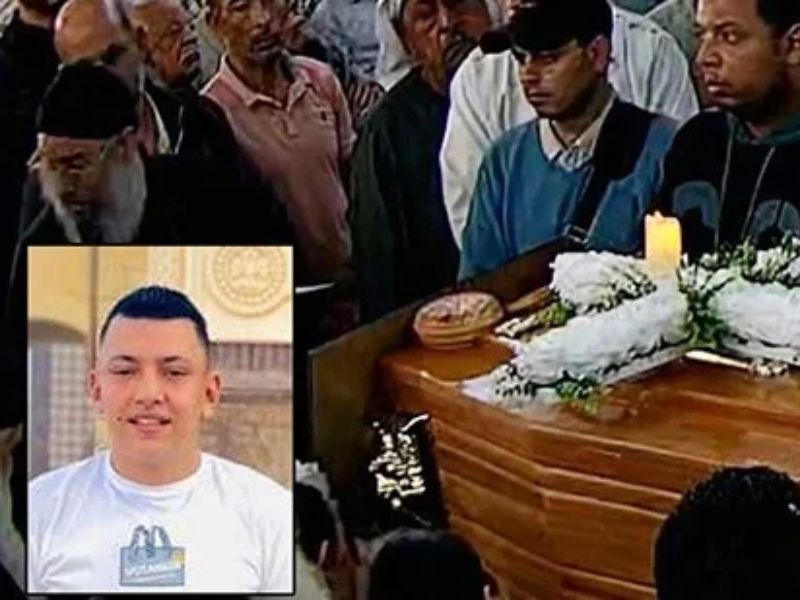
In the quiet village of Sabrbay, nestled in the Nile Delta near the city of Tanta, 20-year-old Milad Malak was widely known for his dedicated service as a deacon at the local Coptic church. However, Egypt's worsening economic downturn forced the young man to seek employment opportunities beyond his homeland's borders. On September 2, Milad packed a few belongings and set out for neighboring Libya alongside two Muslim friends from his village, hoping to support his family and build a stable future.
The journey brought the group to the western Libyan city of Zliten, where they stayed alongside other Egyptian migrant workers. On the morning of October 4, their working routine was violently shattered. An armed militant cell affiliated with the Islamic State group raided the quarters and abducted the workers. On the morning of October 6, around 11:00 AM, Milad's family in Egypt received a distressing message sent by the young man himself, informing them that he had been kidnapped and that the captors were demanding a $4,700 ransom for his release. During his captivity, milad malak was kidnapped by militants linked to the islamic state in zliten while being subjected to severe physical abuse.
The Abduction in Zliten and the Ransom Demand
The families of the two Muslim friends quickly raised funds and paid the required ransom for each of them. According to accounts from relatives and media reports cited by , the kidnappers released the two Muslim young men as soon as the money was delivered. Milad's family also managed to transfer the requested $4,700 ransom. However, the young deacon's fate took a vastly different and tragic turn.
In statements provided to Worthy News, the deacon's sister, Madonna Malek, explained that the extremist faction refused to free him even after receiving the cash. The captors cited Milad's identity as the sole Christian in the group of hostages as the reason for his continued detention. Upon discovering his religious background, the militants subjected him to systematic physical torture and psychological pressure to force him to renounce Christianity and convert to Islam. According to his sister, even after his family paid the 4,700 dollar ransom the kidnappers refused to release him because of his Christian faith.
The pressure on Milad continued for days. In captivity, the young man endured constant death threats and severe physical beatings. The two released Muslim friends, who returned to Egypt for medical treatment at a local hospital, confirmed to Milad's family the details of the interrogations carried out by the extremists.
Despite the intense pain and the immediate threat to his life, the deacon maintained an unshakeable resolve. According to his sister's account, Milad confronted the armed captors with a bold declaration: even if you cut me into pieces i would never renounce my faith the young man told his captors. Realizing that no amount of physical violence would break the young man's spiritual conviction, the militants ultimately executed him. The precise date of his death and the exact circumstances of his execution were not released by local authorities, but the two muslim friends traveling with milad were released and hospitalized in egypt where they testified to their companion's courage.
Family Mobilization and the Funeral in the Nile Delta
After learning of Milad's death from the surviving workers, his family began an agonizing effort to recover his remains. Milad's mother, Maryam Fawzi, issued public appeals to government authorities, requesting direct intervention from Egyptian President Abdel Fattah el-Sisi and the Foreign Ministry to repatriate her son's body.
After weeks of diplomatic appeals and waiting, Milad's body was finally returned to Egypt. On October 28, hundreds of mourners, including Coptic clergy, community leaders, and residents from across Gharbia governate, gathered at the historic Church of the Archangel Michael in the village of Sabrbay. During the funeral service, marked by deep grief and prayers, hundreds of mourners gathered at the church of the archangel michael for the funeral on october 28 to honor the deacon's memory. A family friend and evangelical ministry worker told news outlets that the young man remained faithful to Christ until his last breath. His mother's determination proved crucial, as the young mans mother appealed to the egyptian president to secure the repatriation of her sons body until he could receive a proper Christian burial.
The Shadow of the 2015 Massacre and the Migrant Crisis
Milad's murder sparked widespread sorrow across Egypt's Christian community and reopened historical wounds concerning the safety of migrant workers in Libya. The incident immediately recalled the massacre of February 2015, when Islamic State militants beheaded 20 Egyptian Coptic Christians and one Ghanaian Christian on a Libyan beach. At that time, the mass execution was filmed and broadcast worldwide by the terrorist group, making the victims known internationally as the 21 Coptic martyrs of Libya.
Rights advocates and persecution monitors note that the case revived memories of the 21 christians beheaded by the islamic state on a libyan beach in 2015 while highlighting the extreme hazards faced by religious minorities in North Africa. Egypt's lingering economic hardship forces thousands of young Christian men to seek employment in neighboring Libya despite the collapse of state institutions and the dominance of radical militias.
According to data from Open Doors, Egypt ranks 42nd on the World Watch List of countries with severe religious persecution, housing approximately 10.2 million Christians, or 8.8 percent of the population. Libya ranks as the 9th most dangerous place in the world for Christians, with a small Christian population of around 36,300, representing roughly 0.5 percent of the total population. In Libya, libya ranks ninth on the persecution watch list with only 36 thousand christians and believers face kidnappings, forced labor, and executions carried out by criminal gangs and jihadist cells.
The Grain of Wheat and a Spiritual Legacy in North Africa
Milad Malak's journey is viewed by Christian leaders as a contemporary testament to unyielding faith in the face of tyranny. In the Christian tradition, personal sacrifice for faith echoes the words of Jesus in John 12:24, where He teaches that unless a grain of wheat falls into the earth and dies, it remains alone, but if it dies, it bears much fruit. Thus, according to scripture in john 12 the grain that dies bears much fruit for the strengthening of the global Church.
In the village of Sabrbay, the atmosphere following the funeral remains one of quiet reflection and mourning. Residents continue to gather at the Church of the Archangel Michael, where Milad served at the altar prior to his departure. Friends and family cherish the memory of the 20-year-old who chose to face torture and death rather than deny his Lord, leaving a lasting legacy in the history of Egypt's Coptic Church.
The Herald covers what almost no one else does: the persecuted church, the discovery that confirms the Bible, the faith that never makes the evening news. No subscription, no paywall, no outside advertisers. If this story mattered to you, help the next one get written.