800-Year-Old Medieval Organ Built for Bethlehem Nativity Church Sounds Again in Jerusalem
Crusader bronze pipes buried in 1244 to avoid destruction reveal working notes and original sounds from 11th-century worship.
By Nikolai Witoszynski2 min read
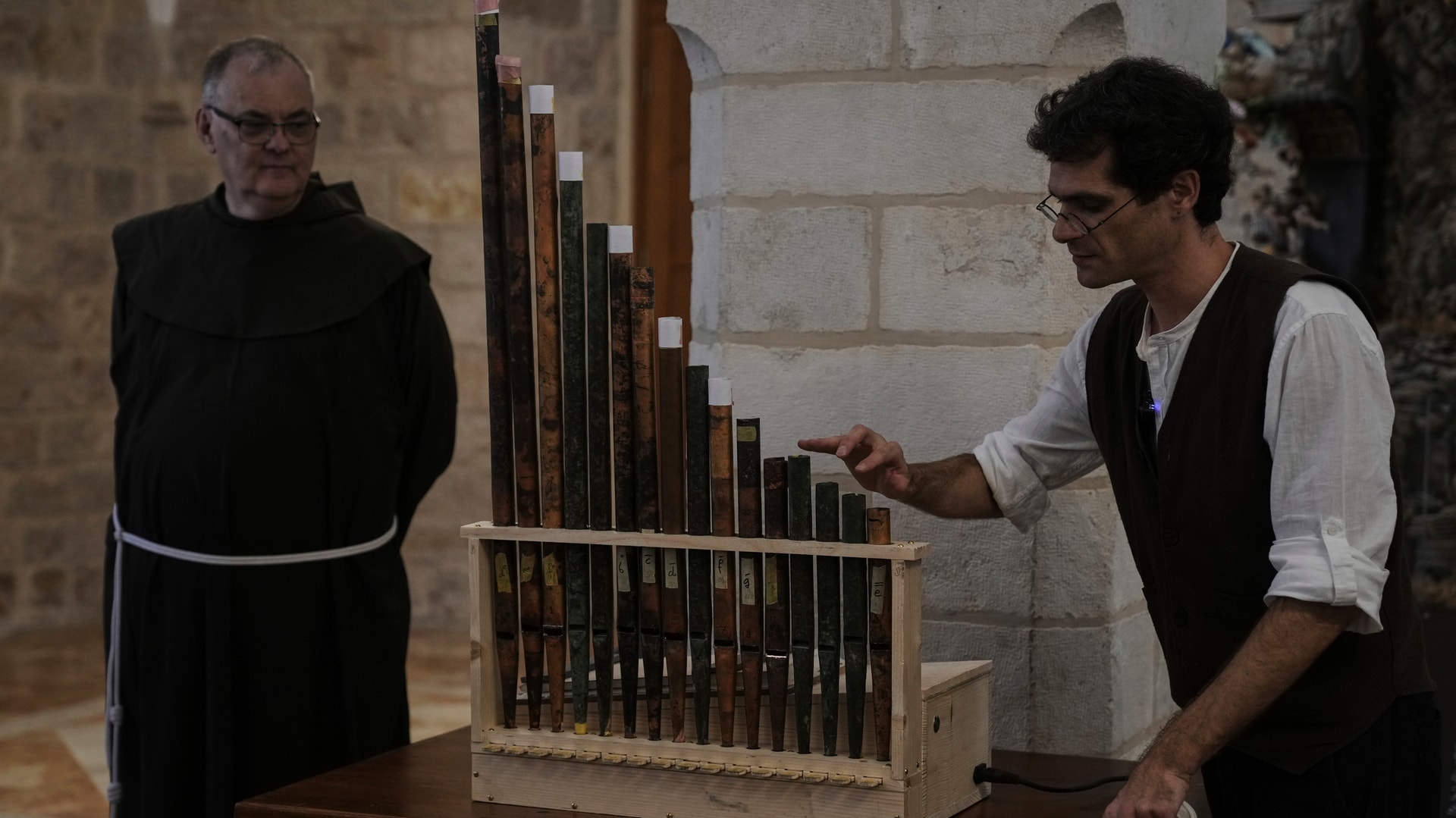
David Catalunya, a Valencian musician and musicologist displays an 11th-century organ that researchers say is the oldest in the Christian world was played for the first time in 800 years after restoration, in Saint Savior's Monastery of Jerusalem's Old City, Tuesday, Sept. 9, 2025. Credit: AP/Mahmoud Illean Photo: Newsday (aguardando autorização)
In September 2025, the sound of an 800-year-old medieval organ filled a hall in Jerusalem once more. Spanish musician and musicologist David Catalunya performed the liturgical chant Benedicamus Domino Flos Filius using six original 11th-century bronze pipes during a demonstration at Saint Savior's Monastery.
The instrument originally belonged to the Church of the Nativity in Bethlehem, the site of Jesus's birth. Brought to the Holy Land by Crusaders in the 12th century, the organ played in the sanctuary for about a century before it was dismantled and buried.
In 1244, as Turkic forces advanced on Jerusalem and Bethlehem, local Christians disassembled the instrument to save it from destruction. The pipes and a set of bells were buried in an ancient cemetery adjacent to the church.
The organ remained underground until 1906, when workers constructing a Franciscan hospice for pilgrims uncovered the site. Archaeological excavations at the site recovered 222 bronze pipes, bells, and mechanical parts preserved under the soil.
In 2019, a research team led by Catalunya at the Instituto Complutense de Ciencias Musicales in Madrid began studying the collection. The team conducted more than 5,000 measurements and metallographic analyses to reconstruct how medieval craftsmen crafted the metal.
During testing, researchers discovered that some of the original pipes still produced sound perfectly without requiring alterations to their metal structure. Organ builder Winold van der Putten mounted these original pipes alongside replicas constructed using 11th-century methods.
European craftsmen carved guide lines and musical note notations into the original bronze pipes nearly a thousand years ago. Organ expert Koos van de Linde noted that the metal's preservation allowed listeners to hear the exact tone used in medieval Christian worship.
Researchers are working to complete a full replica of the medieval instrument. The final instrument will be displayed at the Terra Sancta Museum in Jerusalem's Old City. Psalm 150:4 reflects the long tradition of praising God with stringed instruments and organs.
The Herald covers what almost no one else does: the persecuted church, the discovery that confirms the Bible, the faith that never makes the evening news. No subscription, no paywall, no outside advertisers. If this story mattered to you, help the next one get written.