Chaldean monks return 93 historic manuscripts saved from war in Iraq after more than 50 years
The collection from the former Diocese of Akra moved through four cities before being restored and handed over in Erbil.
By Nikolai Witoszynski4 min read
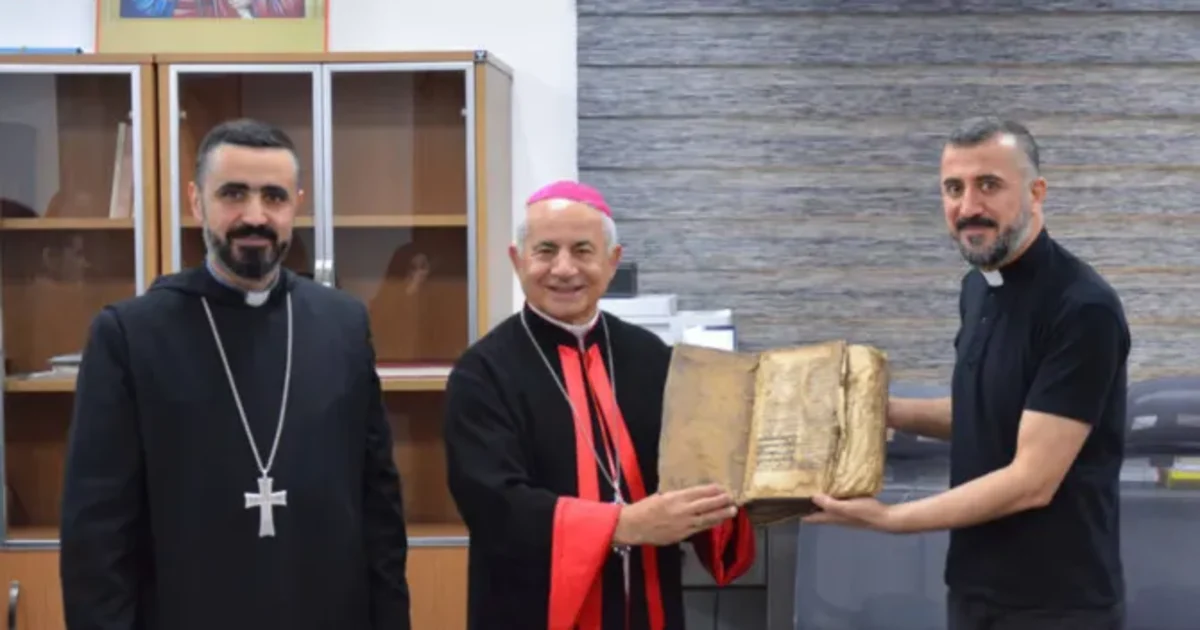
After safeguarding the manuscripts of the Diocese of Akra for more than half a century, the Chaldean Antonian Order of St. Hormizd returns the collection to its ecclesiastical authorities. | Credit: Chaldean Antonian Order of St. Hormizd Photo: EWTN News (aguardando autorização)
In the Ankawa district of Erbil, a ceremony at the Monastery of the Servant of God and Martyr Gabriel Danbo brought to a close a 50-year journey of safeguarding Christian heritage. Before ecclesiastical leaders of the Chaldean Catholic Church, the Chaldean Antonian Order of St. Hormizd officially handed over a historical collection of documents that survived decades of conflict and displacement in northern Iraq. Após mais de meio século de proteção e transferências secretas, 93 manuscritos históricos foram devolvidos à Arquidiocese de Mossul e Akra. Archbishop Najeeb Michaeel received the collection from Abbot Samer Soreshow, superior general of the order, marking a victory for Christian memory in a region where Syriac-speaking communities have lived since the dawn of the Church.
The effort to protect these volumes began in the 1960s, when political instability and armed conflicts threatened Christian villages across northern Iraq. At the time, the Chaldean Diocese of Akra held a rich library containing liturgical texts, biblical manuscripts, and local historical records accumulated over centuries. Fearing lootings and the destruction of local heritage, Father Abdul-Ahad Rabban took steps to secure the codices. He entrusted the documents to the care of his religious order until conditions allowed for their safe return to diocesan authorities.
A iniciativa de salvar o acervo partiu do frei Abdul-Ahad Rabban, que mais tarde tornou-se bispo da diocese de Akra.
Preserving ancient books in a country repeatedly hit by violence required constant movement. The Akra manuscripts did not stay in a single refuge, but moved alongside the monks whenever danger approached. Their first haven was the Monastery of Our Lady of the Seeds in Alqosh. However, as regional clashes intensified, the manuscripts had to be transferred to St. George Monastery in Mosul, and later brought to the capital, Baghdad, where they were kept at St. Anthony Monastery. O acervo passou pelo Mosteiro de Nossa Senhora das Sementes em Alqosh, São Jorge em Mossul e Santo Antônio em Bagdá.
It was only in 2021 that the collection reached the general headquarters of the Chaldean Antonian Order in Ankawa, the predominantly Christian district of Erbil that has sheltered thousands of displaced families over the past decade. The headquarters houses the Scriptorium Syriacum, a cultural center dedicated to preserving, restoring, and digitizing Syriac manuscripts. Repeated relocations over 50 years caused the Akra manuscripts to mix with other collections owned by the order, necessitating years of careful sorting.
Painstaking Restoration at the Scriptorium Syriacum
To identify and catalog the manuscripts belonging to Akra, the monks turned to historic catalogs compiled by notable scholars and orientalists. They consulted works by Bishop Addai Scher, Belgian Dominican orientalist Jacques-Marie Vosté, and Fathers Yousif Habbi, Boutros Haddad, and Jacques Isaac, as well as publications from the Iraqi Academy dating back to 1988. Guided by these records, the team led by Father Yousif Ajim began identifying the volumes.
The restoration team included graduates from the Department of Syriac Language at Salahaddin University in Erbil. Pages of parchment and handmade paper suffered from damage caused by time, humidity, and dust. A equipe do centro cultural lavou as páginas, reuniu folhas dispersas e fotografou cada volume. The restoration included reordering page numbers, rebinding complete volumes, and preparing detailed catalog entries. The work was particularly delicate because the Monastery of Our Lady of the Seeds had produced multiple manuscript copies of the same liturgical texts in past centuries.
Os monges precisaram separar as obras misturadas durante as constantes fugas da violência no Iraque. Abbot Samer Soreshow explained to ACI MENA that the order viewed the manuscripts not merely as rare artifacts, but as an essential part of the spiritual memory and identity of the Chaldean Church in the Middle East.
Located Manuscripts and the Single Missing Volume
Historical catalogs indicated that the original collection of the Diocese of Akra comprised 97 manuscripts. Upon completing the restoration, the order handed over 93 complete volumes to Archbishop Najeeb Michaeel. Of the four remaining texts, three were located in digital archives created in partnership with the Hill Museum & Manuscript Library (HMML) in Minnesota. Três dos quatro textos restantes foram localizados em arquivos digitais no estado de Minnesota. Only one manuscript from the original inventory remains missing.
The formal transfer returns ownership to the regional archdiocesan structure. The Diocese of Akra functioned independently until ongoing conflict dramatically reduced the local Christian population. In 2018, the Holy See merged the jurisdiction with the neighboring Archdiocese of Mosul, forming the Chaldean Catholic Archeparchy of Mosul and Akra, currently led by Archbishop Najeeb Michaeel, who himself played a famous role in saving thousands of ancient manuscripts during the ISIS invasion of 2014. A antiga Diocese de Akra foi unificada à Arquidiocese de Mossul após décadas de êxodo da população cristã.
The Spiritual Legacy of Christianity in Mesopotamia
Preserving sacred texts and liturgies written in Aramaic and Syriac holds profound meaning for Iraq's Christian community, which preserves liturgical traditions dating back to apostolic times. Scripture emphasizes the value of recording God's deeds for future generations, as written in Psalm 102:18: "Let this be written for a future generation, that a people not yet created may praise the Lord." The Chaldean monks grounded their decades of guardianship in this mandate to pass down the roots of faith.
At the conclusion of the handover in Ankawa, Abbot Samer Soreshow highlighted the significance of the return. O superior geral ressaltou que a entrega garante a continuidade da missão histórica da Igreja no Oriente Médio. The 93 restored manuscripts are now part of the archdiocesan archives, accessible to researchers, historians, and clergy studying the history of the Church in Mesopotamia.
The Herald covers what almost no one else does: the persecuted church, the discovery that confirms the Bible, the faith that never makes the evening news. No subscription, no paywall, no outside advertisers. If this story mattered to you, help the next one get written.