Silver 3-inch goblet found in the West Bank may feature the world's oldest depiction of the cosmos
Study in the Journal of the Ancient Near Eastern Society indicates Bronze Age relief predates the Enuma Elish creation epic by roughly a thousand years.
A silver goblet measuring just 3 inches tall, discovered in 1970 near the city of Nablus in the West Bank, has returned to the center of archaeological debate. A study published in the *Journal of the Ancient Near Eastern Society* contends that the scenes hammered onto the metal vessel represent the earliest written or artistic representation of a cosmogony ever discovered in the world.
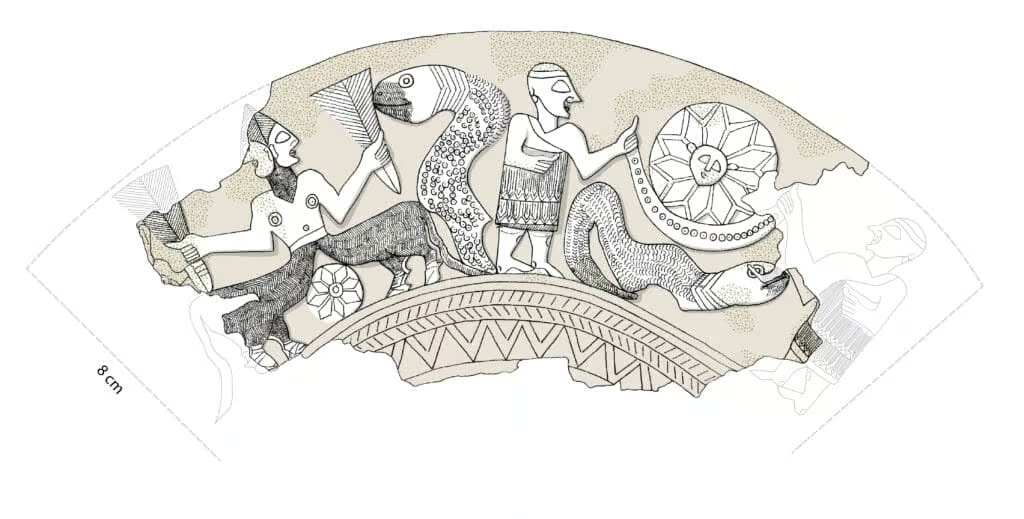
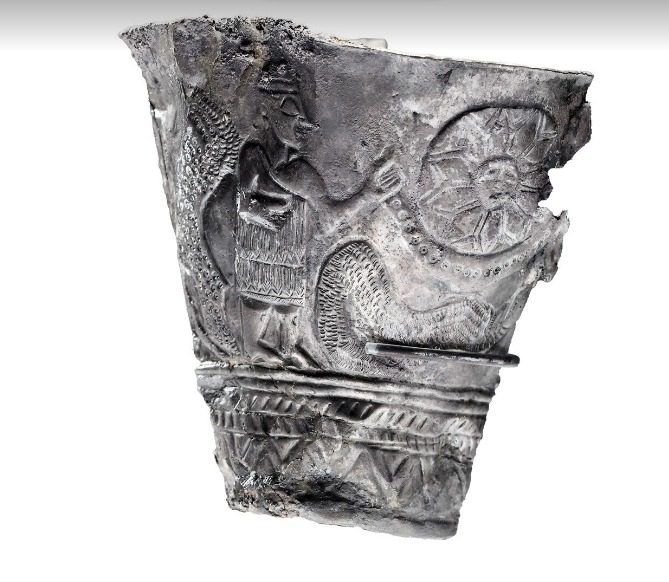
The artifact was excavated by archaeologist Zeev Yeivin from an Intermediate Bronze Age tomb, dated between 2650 BC and 1950 BC. The site was part of a large necropolis serving several major settlements in the area of Ain Samiya. The cup features two artistic scenes hammered in relief, showing human figures, snakes, celestial symbols, and a chimera.
When the goblet was first uncovered, archaeologist Yigael Yadin suggested the relief depicted the Babylonian creation epic, the Enuma Elish. Yadin proposed that the scenes showed the battle between the god Marduk and Tiamat. Later scholars questioned that interpretation because the Ain Samiya goblet predates the Babylonian text by hundreds of years, and several visual details do not match the Enuma Elish story.
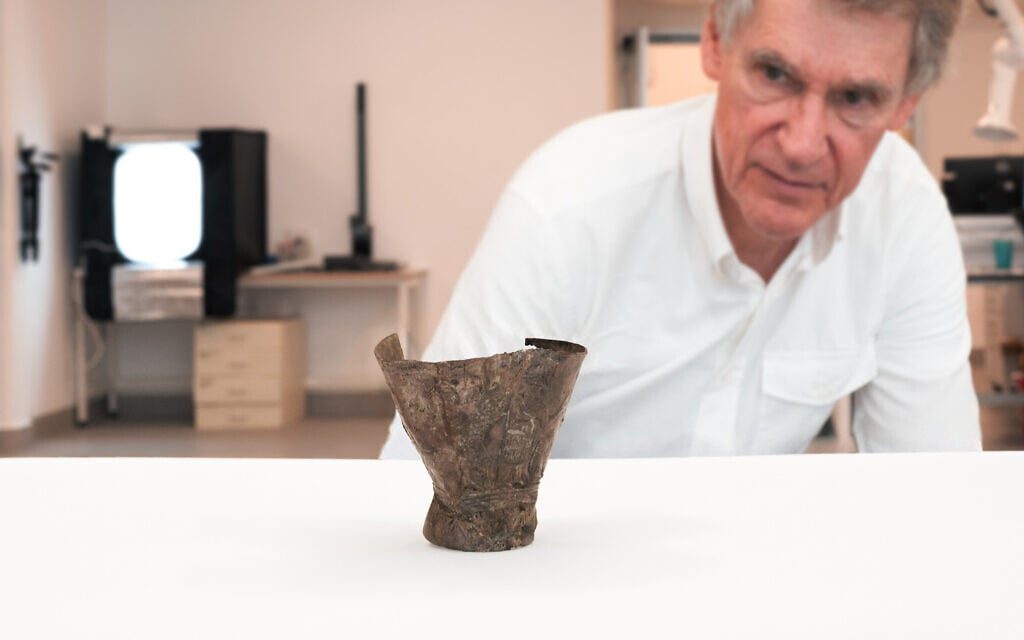
Swiss geoarchaeologist Dr. Eberhard Zangger next to a rare silver chalice found at Ain Samiya, near Ramallah in the West Bank, dated to around 2300 BC and now on display at the Israel Museum in Jerusalem. Photo: 18Israel
The heavenly boat and victory over the serpent of chaos
The authors of the new study state that the key to unlocking the artifact lies in the second carved panel. The scene displays a crescent shape stretching between two human figures. The researchers identified this structure as the boat of heaven, a well-known motif in ancient Near Eastern art representing the sun or moon traveling across the sky.
Identifying the boat allowed scholars to decipher the remaining symbols on the cup. The first panel portrays primordial chaos. A deity appears in the form of a chimera, combining divine, plant, and animal traits. Opposite the chimera rises a large serpent, a widely recognized symbol of chaos. Below the chimera lies a newborn sun, not yet fully formed.
In the second panel, two separate deities hold up the boat of heaven. Resting on the boat is the sun, carved with a human face that marks it as both the celestial body and the sun god. Below the boat, the serpent lies defeated and banished from the overworld. Study co-author Daniel Sarlo explained that the vessel shows a peaceful process of cosmic ordering, where the sun is born and banishes chaos, presenting a view of creation that predates the Babylonian Enuma Elish by over a thousand years.
How did a Mesopotamian artifact end up in Canaan?
The origin of the goblet raises questions regarding cultural exchanges during the Bronze Age. While the serpent and the boat of heaven were familiar motifs across the Near East, other elements are region-specific. The chimera on the cup features a human head joined to a two-bodied bull, a motif originating in Mesopotamia.
The clothing worn by the deities on the goblet matches the styles seen on representations of Mesopotamian gods from the third millennium BC. Furthermore, the southern Levant lacked silver mining and advanced silversmithing during this period.
The researchers conclude that either the owner or the maker of the cup came from Mesopotamia. The vessel arrived in Canaan through trade networks or population migrations. The presence of an object featuring decorative elements and attire typical of third-millennium BC Mesopotamia inside a local tomb demonstrates the transmission of religious concepts and metallurgy between the Euphrates and the hills of Canaan.
Why is the Ain Samiya goblet important for Biblical studies?
For readers of Scripture, the goblet provides physical evidence of the antiquity of creation concepts in the ancient Near East. The depiction of the serpent as a representation of chaos, a recurring figure in Old Testament narratives such as Genesis 3, shows that specific motifs were present in the region long before the biblical text was finalized.
Unlike Babylonian myths defined by violent wars between gods, the Ain Samiya cosmogony portrays the transition from disorder to order directly. The discovery confirms that inhabitants of the Holy Land were connected to complex regional networks. The presence of a crafted silver vessel indicates that finely crafted silver indicates trade routes or population migration into Canaan well before the patriarchal period.
The Herald covers what almost no one else does: the persecuted church, the discovery that confirms the Bible, the faith that never makes the evening news. No subscription, no paywall, no outside advertisers. If this story mattered to you, help the next one get written.