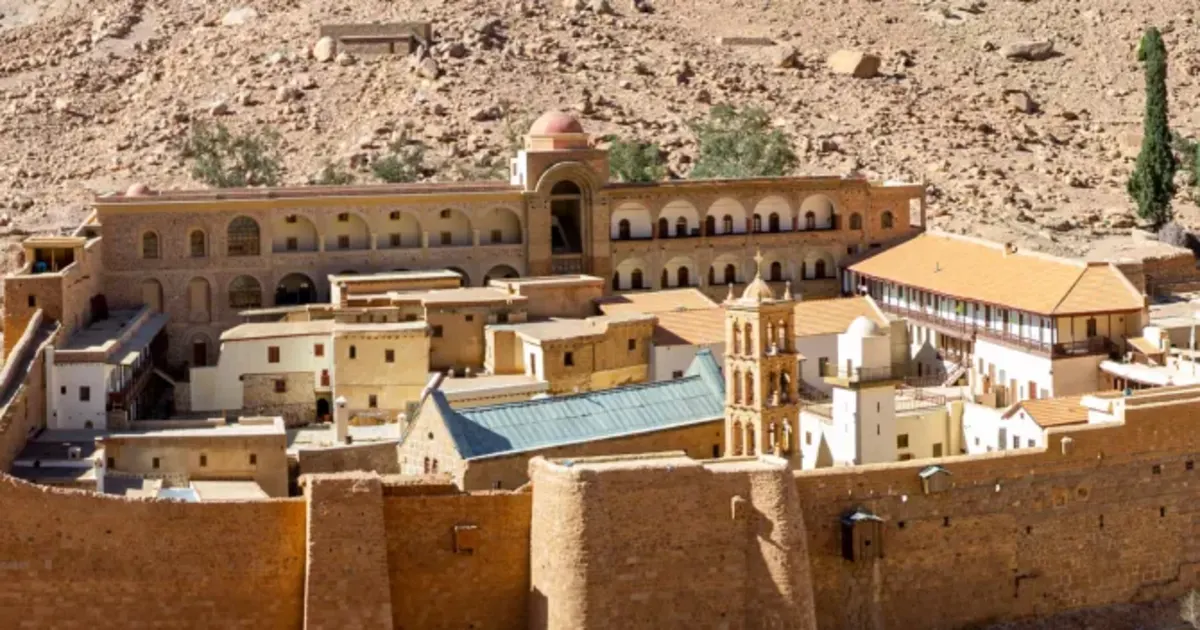
On the arid slopes of Mount Sinai, where biblical tradition records that Moses beheld the burning bush and received the Ten Commandments, one of Christianity's oldest sanctuaries is preparing to sign a landmark agreement. St. Catherine's Monastery and the Egyptian government are on the verge of finalizing a legal settlement to resolve a prolonged land dispute that threatened the monastic community's legal standing. The proposed agreement regulates the monastery's legal status under Egyptian sovereignty, ensuring the uninterrupted continuation of Christian monastic life in the peninsula.
The formal announcement was made by Archbishop Symeon Papadopoulos, abbot of the monastery and Archbishop of Sinai, Pharan, and Raitho. In a letter to Egyptian Foreign Minister Badr Abdelatty, the monastic leader confirmed his readiness to sign the official contract as soon as his health permits following a stay in Greece. The settlement concludes months of legal uncertainty stemming from local court rulings and ensures that the brotherhood of monks continues to manage the sacred complex without fear of forced eviction.
2025 court ruling triggered crisis and eviction threat
The legal dispute escalated dramatically in May 2025 when the Ismailia Court of Appeal ruled in favor of a lawsuit filed by the South Sinai Governorate. The court determined that the monastery lacked formally recognized property titles to the lands surrounding the monastic citadel, imposing a 10 million Egyptian pound fine and ordering the monks to vacate 72 plots of land cultivated by the brotherhood.
The judicial decision prompted immediate diplomatic concern between Athens and Cairo. Founded in the 6th century by Byzantine Emperor Justinian I, the monastery is home to a brotherhood of Greek monks operating under the ecclesiastical jurisdiction of the Greek Orthodox Patriarchate of Jerusalem. In response to the ruling, Cairo officials and Church representatives engaged in confidential negotiations to avoid eviction proceedings and identify a solution aligned with both Egyptian law and ecclesiastical canon.
To allow time for the settlement process, Egypt's Court of Cassation postponed its final hearing on the monastery's appeal until December 27. The postponement aims to enable the bilateral agreement to be signed before the high court issues a definitive ruling, resolving the matter out of court.
Key provisions of the agreement between monks and the Egyptian state
The negotiated contract establishes a clear distinction between strictly ecclesiastical properties and non-ecclesiastical or agricultural land. For the main religious complex and sites of worship, the agreement guarantees the free right of possession, use, and occupation in perpetuity without any time limit. Although the Egyptian state does not grant full civil real estate ownership to the Church under national law, it secures effective control and management of the facilities for the archbishop and the monks.
For non-ecclesiastical land, including agricultural plots cultivated by the monks over decades, the solution involves a land grant under Egyptian law with nominal lease payments to the government. This arrangement allows the monastic community to maintain its agricultural livelihood within the national legal framework.
The final text also imposes strict protective covenants. Neither the monastic brotherhood nor the Egyptian state will be permitted to sell, transfer, or lease the protected monastery to third parties, placing legal responsibility on Egyptian authorities to enforce the prohibition against any property alienation.
Beyond land rights, the settlement addresses administrative matters for the community. All resident monks are foreign nationals and will benefit from streamlined residence permit renewals. Egyptian President Abdel Fattah el-Sissi is expected to issue a presidential decree formally recognizing Archbishop Symeon as head of the monastery, enabling official banking and administrative functions. This decree follows the precedent set in the 1970s by late President Anwar Sadat regarding Symeon's predecessor, Archbishop Damianos.
Mount Sinai in Scripture and an unbroken monastic heritage
The significance of St. Catherine's Monastery extends far beyond regional borders to the foundational history of the Christian world. The site rests at the foot of Mount Horeb, described in Exodus 3:1-6, where God appeared to Moses in a flame of fire out of the midst of a bush that burned without being consumed. Nearby, according to Exodus 19:16-25, the covenant was established with the giving of the Ten Commandments.
Monastic life at the site dates back to the 4th century when Empress Helena, mother of Constantine, ordered a chapel constructed at the traditional location of the burning bush. In the 6th century, Emperor Justinian I fortified the sanctuary with massive stone walls to protect hermit monks from desert raids. The monastery has remained continuously inhabited for more than 1,400 years, enduring regional conflicts, imperial transitions, and political shifts.
The library and artistic treasury preserved by the monks represent one of humanity's greatest cultural heritages. The monastery holds the world's second-largest collection of early Christian manuscripts, behind only the Vatican Library, including portions of the 4th-century *Codex Sinaiticus*. The repository also preserves rare 5th- and 6th-century encaustic icons that survived the Byzantine iconoclastic controversy due to Sinai's remote location.
Researcher Nader Shukry, specializing in citizenship and Coptic affairs, told ACI MENA that the settlement earned formal support from five major Greek Orthodox jurisdictions: the Ecumenical Patriarchate of Constantinople, the Patriarchates of Jerusalem and Alexandria, and the Churches of Greece and Cyprus. Each jurisdiction issued synodal letters endorsing the terms.
The Great Transfiguration project and internal church debate
The pending agreement coincides with Egypt's implementation of the Great Transfiguration project, a state infrastructure initiative designed to develop the city of St. Catherine into an international destination for religious tourism. The plan includes expanding the local airport, building new lodging facilities, and constructing visitor centers around the surrounding national protectorate.
Officials and analysts state that the development project does not alter the physical structure or spiritual life of the monastery itself. Shukry dismissed rumors claiming Egyptian authorities intended to evict the brotherhood or assume control of the sanctuary, explaining that state efforts focus on regional tourism while preserving monastic autonomy.
Despite widespread institutional endorsement, opposition persists among a minority of clergy and monks. Former abbot Damianos and several religious figures oppose any contract recognizing state ownership over monastic land. Opponents argue that historic documents and decrees issued by Muslim rulers preserved in the monastery archives establish full church ownership rights over the property.
Preserving a legacy and next steps before the High Court
Negotiators anticipate the contract will be signed prior to the December 27 Court of Cassation hearing. Once the agreement is executed and the presidential decree is issued, pending court cases are expected to be formally dismissed.
The resolution provides legal stability for the Christian presence in the Sinai Peninsula while strengthening bilateral relations between Egypt and Greece. For the monastic brotherhood guarding the foot of the holy mountain, daily life of prayer, liturgy, and welcoming pilgrims continues without pause.
Reflecting on the outcome of the negotiations, Archbishop Symeon confirmed that monastic operations remain normal. The monks remain dedicated to their spiritual calling and the stewardship of one of Christianity's oldest living heritages.
The Herald covers what almost no one else does: the persecuted church, the discovery that confirms the Bible, the faith that never makes the evening news. No subscription, no paywall, no outside advertisers. If this story mattered to you, help the next one get written.