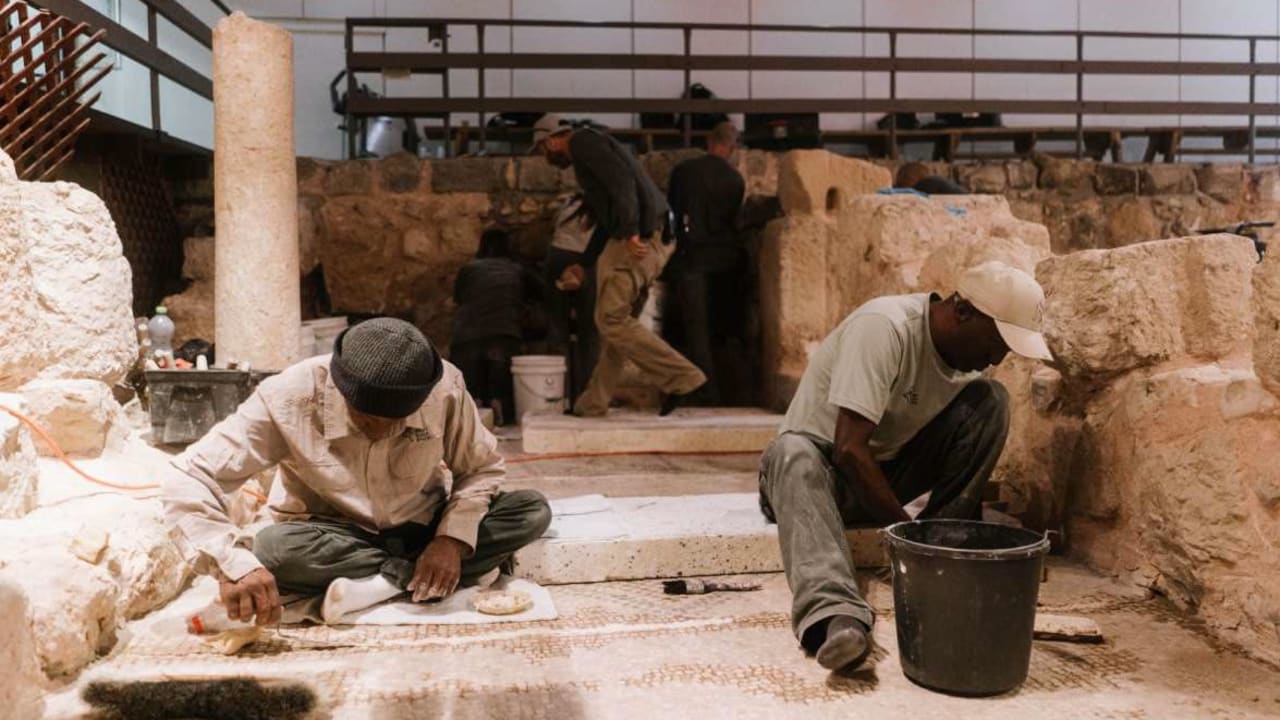
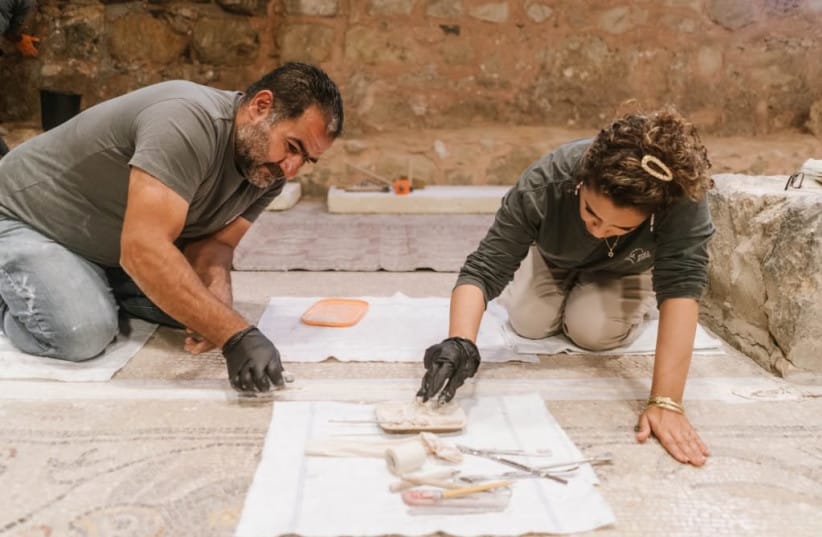
Under the careful lighting of conservation equipment in northern Israel, a team of restorers worked on their knees to protect one of the most striking visual records of biblical history. In a single-day intensive operation, about 20 specialists gathered at Beit Alfa National Park to preserve the 1,500-year-old mosaic floor belonging to the region's ancient synagogue.
The conservation project was organized by the Archaeology and Heritage Division of the Israel Nature and Parks Authority, bringing together specialists from across the country. Working in unison to prevent degradation over time, the team cleaned the surface, stabilized loose stones, and refilled gaps with materials compatible with the originals using the repointing technique.
As reported by The Jerusalem Post, the entire operation was accompanied by detailed documentation before and after completion. This monitoring will guide the planning of future maintenance and ongoing conservation steps at the historical site.
Byzantine synagogue layout and conserving 800,000 stones
Built during the Byzantine period at the end of the fifth century CE, the Beit Alfa synagogue features an architectural layout consisting of a courtyard, an entrance corridor, a rectangular main hall with the mosaic floor, a second-story balcony, and an additional room.
Israeli conservationists work to preserve the Beit Alfa mosaic in northern Israel, November 6, 2026. (credit: Alona Ahmatov, ISRAEL NATURE AND PARKS AUTHORITY) Photo: The Jerusalem Post | JPost.com
Orit Bortnik, Director of the Israel Nature and Parks Authority Archaeology and Heritage Division, highlighted both the visual impact and historical weight of the structure. According to Bortnik, more than 800,000 tiny mosaic stones come together to tell a fascinating story about the people who lived there and the craftsmen who created the work.
She explained that assembling experts from across the nation allowed complex tasks that would normally take several days to be completed in a single afternoon. The preservation ensures that future generations can continue to be moved by the monument.
The floor of Beit Alfa preserves two inscriptions vital for its dating and attribution. An Aramaic inscription, which lost most of its right-hand section over the centuries, notes that the mosaic was laid during the reign of Emperor Justinian I, who ruled from 527 to 565 CE.
A second inscription written in Greek explicitly names the artists responsible for the mosaic: Marianus and his son Hanina. The same names appear in an inscription at the ancient synagogue in nearby Beit She'an, suggesting their workshop was based in that city.
The mosaic was discovered in 1928 by Professor Eleazar Lipa Sukenik of the Hebrew University of Jerusalem, a key figure in Israeli archaeology. Sukenik was among the first to recognize the significance of the Dead Sea Scrolls and helped purchase them for the state. His son, Yigael Yadin, later served as the second IDF Chief of Staff and led famous excavations at Masada, Tel Megiddo, and the Judean Desert.
The Binding of Isaac depicted in ancient synagogue tiles
The floor mosaic is divided into three colorful panels rich in narrative detail. The lower panel depicts the biblical narrative of the Binding of Isaac, recorded in Genesis 22:1-19.
In the artwork, the panel depicts a bearded Abraham holding a knife over his son Isaac beneath a divine hand, with both figures identified by their Hebrew names. Positioned near the heavenly hand, next to the hand in the mosaic, God's biblical command not to lay a hand is inscribed in Hebrew, referencing the exact words of Genesis 22:12.
This artistic depiction inside a Byzantine-era Jewish house of worship shows how biblical stories were taught and remembered visually by the ancient community.
The zodiac wheel and the Ark of the Covenant
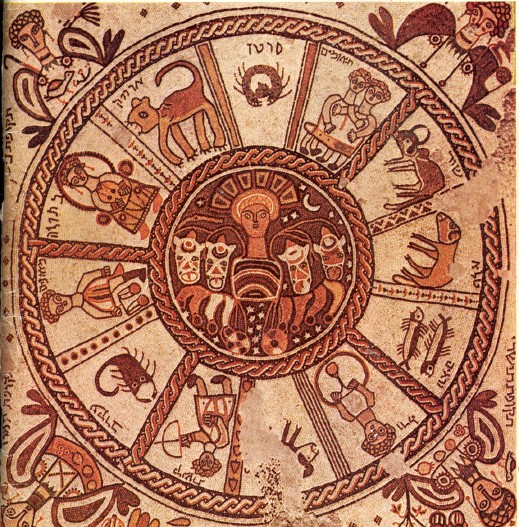
The central panel features a zodiac wheel with all twelve signs labeled in Hebrew script. At the center of the wheel, the Greek sun god Helios drives his chariot across the heavens. The circle is framed by a square with four female figures in the corners, each representing one of the four seasons.
The upper panel, positioned near the prayer niche, depicts the Ark of the Covenant crowned by a pediment containing a shell motif and birds.
Flanking the sacred ark, the upper panel features the Ark of the Covenant flanked by two seven-branched menorahs and two lions, along with other ceremonial ritual objects including a shofar, an incense shovel, an etrog, and a lulav. Bortnik concluded by inviting visitors to experience up close the remarkable beauty and history preserved in the tiny stones of Beit Alfa.
The Herald covers what almost no one else does: the persecuted church, the discovery that confirms the Bible, the faith that never makes the evening news. No subscription, no paywall, no outside advertisers. If this story mattered to you, help the next one get written.