Not yet confirmedUnder investigation. Here is what is known and what still needs proof.
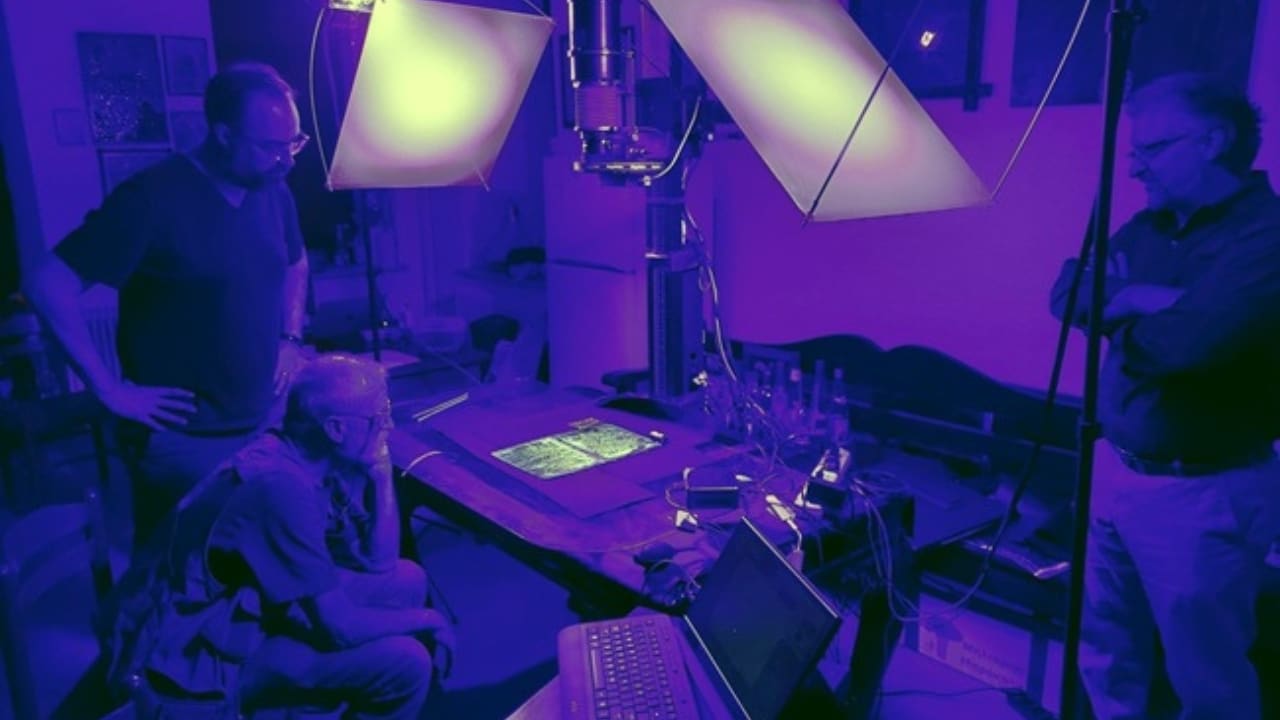
Deep inside an archaeological excavation trench, the difference between soil worked by human hands a thousand years ago and the surrounding natural earth can be as subtle as a slight variation in the shade of brown. To the human eye, even when trained by decades of field experience, decomposed organic matter, ash from ancient fires, and weathered bone fragments often merge into an indistinct mass. To overcome this limitation of human sight, researchers from Aarhus University and Moesgaard Museum in Denmark developed a new multispectral lighting technology based on light-emitting diodes, known as LEDMSI.
Instead of illuminating dirt walls with conventional white light or yellowish construction lamps, the device engineered by the Danish team subjects the soil surface to 16 different light wavelengths, ranging from near-ultraviolet to near-infrared. The reason for multiplying light frequencies lies in the physics of materials: every mineral component, organic residue, or fragile bone absorbs and reflects specific wavelengths in entirely distinct ways. Details of the innovation and initial trials were published in the scientific journal *Journal of Archaeological Science*.
Associate Professor Søren Munch Kristiansen, a geologist at Aarhus University and one of the project leaders, explained that the group's main goal was to modernize field routines without inflating costs. According to him, the team sought to make work faster, clearer, and better in the field at a cost that makes sense for archaeology, and the solution was simply to rethink the light applied to the trench.
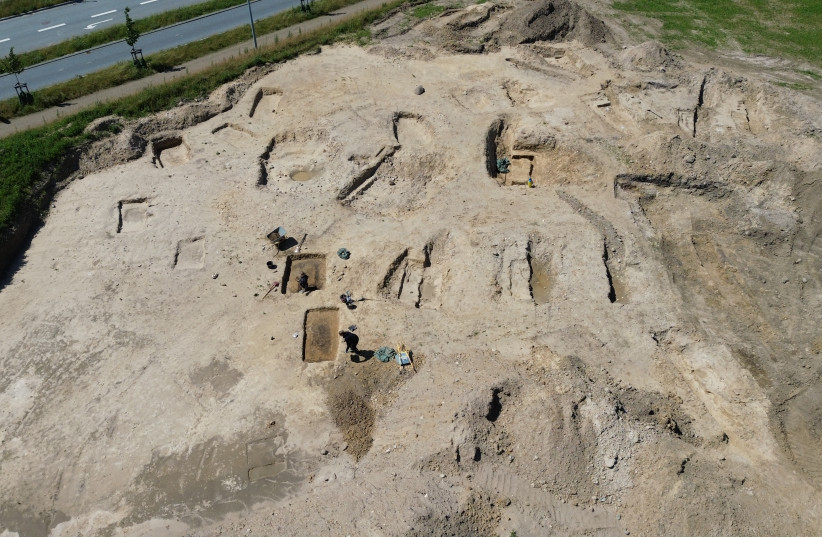
An aerial photo shows archaeologists working at a Viking Age burial site in Lisbjerg, a village seven kilometres north of Aarhus, Denmark's second largest city, on June 13, 2025. (credit: JAMES BROOKS/AFP via Getty Images) Photo: The Jerusalem Post | JPost.com (aguardando autorização)
The first major field test of the prototype took place at the Sorte Muld archaeological site, located on the Danish island of Bornholm. It is an Iron Age settlement famous among researchers for containing more than a meter of deposits built up over centuries of continuous human activity. This density of occupation creates a complex challenge: because the layers are extremely thin and nearly identical in color to the naked eye, archaeologists struggle to determine where one ancient structure ends and the next phase begins.
During the technical demonstration at Sorte Muld, researchers photographed the same vertical section of soil using each of the system's 16 wavelengths. The images were digitally processed and combined on a computer to highlight variations in material reflection that would otherwise remain hidden under sunlight or standard lamps.
The images looked almost psychedelic when captured, and the team only really saw what they had when analyzing them back at the computer, Kristiansen reported. The analysis revealed new soil stratigraphies and fill changes that were completely invisible to the naked eye. Among the features uncovered by the technology at Sorte Muld is a soil trait suggesting a temporary break in human activity at the site, providing new data to reconstruct the occupation timeline.
Another practical effect observed during the Bornholm trial involved the detection of bone fragments. Under the system's ultraviolet light, bones emitted a natural fluorescence that caused them to glow brightly, making it immediately easy to tell organic material apart from surrounding earth. In conventional archaeology, fluorescence photography requires complex optical filters attached to lenses to separate reflected light from emitted fluorescence. The LEDMSI system simplified this procedure by integrating selected illumination directly into field capture equipment.
Second-generation progress and historic transition in Jutland
Following positive results at the Iron Age site, the team developed a second version of the device, equipped with higher-resolution camera sensors and two LED panel units. This second prototype was taken into the field at Fredbjerg, in northern Jutland, where archaeologists are excavating a cemetery dating from the transition between the late Viking Age and early Christian period.
The Fredbjerg cemetery suffers from poor preservation due to the acidity of local soil. Many graves contain very few visible skeletal remains or only faint marks left by decaying bodies and wooden coffins. Archaeologist David Stott from Moesgaard Museum, a co-developer of the system, explained that the team was trying to see if there was information present in the graves that was not otherwise apparent.
At the Fredbjerg excavation, capturing a full set of multispectral images took around 30 seconds, compared to the five minutes required by the first prototype version. This speed allowed researchers to use the data in real time to select exact locations for taking soil samples for subsequent chemical and geological testing, preventing unnecessary damage to adjacent layers.
Scientists are now working to develop fast processing software capable of running directly on laptops at the excavation site and, eventually, on field smartphones or tablets. The team plans to incorporate machine-learning algorithms trained to recognize the spectral signatures of different minerals, charred wood, pottery, and decomposing organic textiles.
Kristiansen noted that teaching an algorithm to differentiate materials is the most challenging part of the project. He compared the current state of field work to a scenario where the geologist and archaeologist have essentially two settings—glasses on or glasses off—while the new system opens up dozens of overlapping ways of seeing the same dirt wall.
The researcher emphasized that artificial intelligence and light sensors will not replace the trained eye and experience of human professionals. The technology was created as an assistive tool to refine the expert's gaze. Kristiansen hopes that in ten years, bringing a multispectral LED system to an excavation will be as normal as carrying a handheld digital camera.
Relevance for biblical archaeology and the Holy Land
The application of low-cost multispectral lighting systems holds direct significance for excavation sites across the Near East and regions tied to Old and New Testament narratives. In Holy Land archaeology, many historical sites consist of *tells*—artificial mounds formed by dozens of superimposed cities built and destroyed over millennia.
At iconic sites such as Jericho, Megiddo, Hazor, and the City of David in Jerusalem, precisely identifying destruction layers from fire, sun-dried mudbrick floors, and wooden post marks is vital for dating historical events. Often, a fire mentioned in biblical texts leaves behind only a millimeter-thin line of ash blended into clay soil. The ability to make soil respond to specific light wavelengths could allow researchers to trace layer boundaries previously lost during manual digging.
Reading stratigraphy is the foundation upon which archaeologists establish the timeline of kings, wars, and cultural shifts. When soil is removed without perceiving the transition between two eras, the evidence is lost forever, as archaeological excavation is inherently destructive. Technologies that reveal the invisible before soil removal preserve the integrity of the historical record.
The unearthing of hidden details beneath the ground reflects principles found in Holy Scripture regarding the manifestation of truth. In Luke 8:17, Jesus declares that there is nothing hidden that will not be disclosed, nor anything concealed that will not be known and brought out into the open. Similarly, Psalm 139:12 reminds believers that even the darkness is not dark to God, and night shines like the day, for darkness is as light to Him. The work of archaeologists illuminating the earth with invisible frequencies echoes this enduring pursuit of bringing historical truth to light.
Although the Danish equipment is still undergoing refinement and testing has focused on Northern European sites, the system's low cost compared to commercial hyperspectral imagers opens the door for adoption by budget-constrained archaeological expeditions worldwide.
As researchers at Aarhus and Moesgaard refine their spectral recognition algorithms, field teams are preparing upcoming tests across diverse soil types. In excavation trenches, the shift from standard white light to multispectral illumination is beginning to transform homogeneous dirt walls into detailed maps of ancient human life.
The Herald covers what almost no one else does: the persecuted church, the discovery that confirms the Bible, the faith that never makes the evening news. No subscription, no paywall, no outside advertisers. If this story mattered to you, help the next one get written.