Not yet confirmedUnder investigation. Here is what is known and what still needs proof.
The Gal'on Fortress in Israel's Guvrin Forest was formally reopened on Thursday, October 29, 2026, after excavation, conservation and accessibility work by the Israel Antiquities Authority (IAA) and the Jewish National Fund (KKL-JNF). It is not a new discovery. It is the permanent opening of a site that its own archaeologists have excavated and published, and that was already open to visitors on a provisional basis.
A reopening, not a discovery
The distinction matters because some headlines read as if the building had just come out of the ground. According to Haaretz, the structure was found in 2018. The IAA announced the find on August 24, 2020, and the site first opened provisionally six years ago. The work now completed improved conservation of the ruins and the visitor experience.
KKL-JNF invested about NIS 400,000. New features include an access road, parking, a picnic area, accessible parking and an accessible path to the fortress, and updated signs. The forest, developed by KKL-JNF since 1963, is planted, so the surroundings visitors see today are not the landscape of the 12th century BCE.
The archaeologists in charge are Saar Ganor of the IAA and Itamar Weissbein of the Hebrew University of Jerusalem. Their full report appeared in the IAA's own journal, 'Atiqot, as . , and the interpretation is where the debate lies.
That is a scientific publication by the excavators, not an independent review of their interpretation
A 59-foot square watching the road between Lachish and Gath
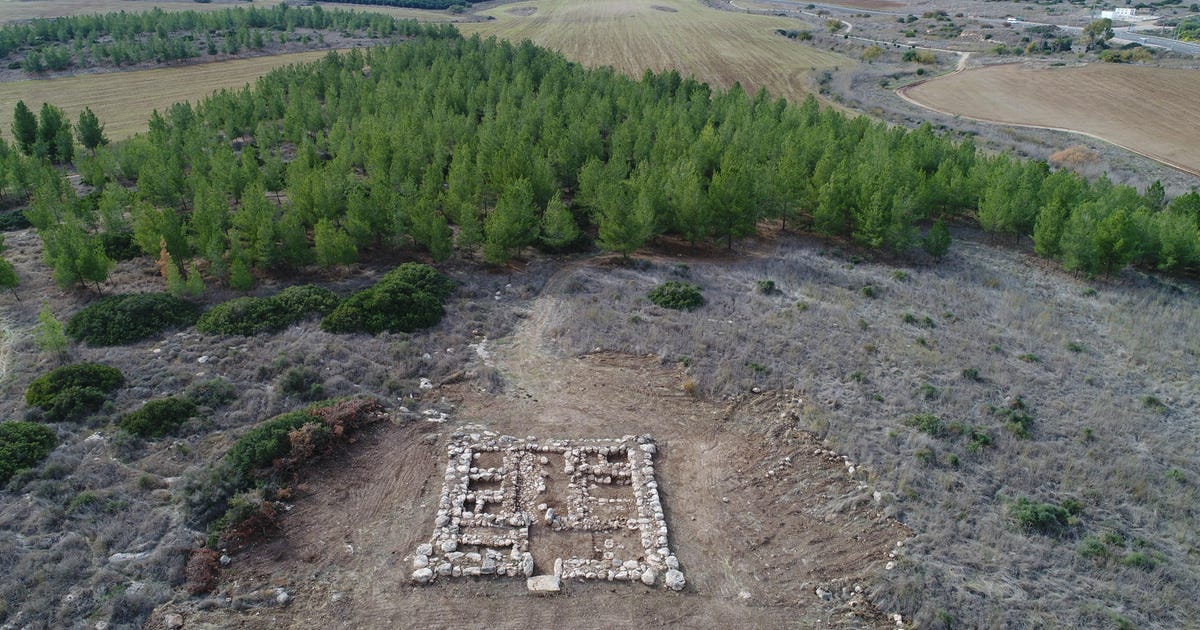
The building stands at Gal'on in the Judean Shephelah, between Tel Zayit and Tel Burna. The Shephelah is the belt of low hills between the coastal plain and the Judean mountains. The site is about 40 minutes south of Jerusalem. It sits beside Nahal Guvrin, and it overlooked a main road linking the area to the coastal plain.
The position was a border one. The excavators' reading is that the building lay between the Canaanite kingdom of Lachish and the Philistine kingdom of Gath. Lachish, today's Tel Lachish, was one of the major cities of southern Canaan. Its rulers appear in the Amarna letters, the Egyptian diplomatic archive of the 14th century BCE.
The structure measures 18 by 18 meters (59 by 59 feet) with watchtowers at all four corners. The entrance keeps a threshold carved from a single stone, weighing about three tons. Inside is a courtyard paved with stone slabs and columns in the middle, with rooms on both sides. According to the IAA's 2020 statement, hundreds of pottery vessels were found, some of them intact. They included cups and bowls that may have been used in ritual. Many bowls copied the style of Egyptian bowls.
The dig drew on students from a Be'er Sheva multidisciplinary school, a pre-military preparatory program and other volunteers.
The journal article describes a single-stratum, isolated building dated to the twelfth century BCE (Late Bronze Age III or Iron Age IA). Those labels cover the transition from the Bronze Age to the Iron Age, when Canaan was still under Egyptian rule. In the abstracts I consulted, the date is tied to comparison with buildings of similar plan and size. I did not find a mention of radiocarbon dating there.
A single stratum means the building was not rebuilt or reoccupied for long. It also means there is no stack of layers, as at a city mound, so the date leans more heavily on comparisons with other sites.
Canaanites, Egyptians or both: what the excavators themselves concede
The 2020 announcement said the fortress was built as a Canaanite attempt to defend against the rising Philistines. In 2026 the archaeologists' wording is more open: the fortress was apparently part of either a Canaanite or an Egyptian attempt to deal with the new geopolitical realities.
The scholarly article points the same way. According to its abstract in 'Atiqot, the building may have been occupied by an Egyptian military force or, more plausibly, by a local Canaanite force tied to the city-state of Lachish. Its construction may relate to the reorganization of Canaan under Egyptian rule, possibly in the reign of Ramesses III. Ramesses III is believed to have reigned from 1185 to 1154 BCE. A reader who sees “built by Canaanites under Egyptian control” is seeing a simplified version of a hypothesis the authors state with caution.
The political setting is well known. The building resembles other structures called “Governors' Residencies” in plan and size, which are linked to Egyptian imperial rule in Canaan in the 19th and 20th Dynasties. After the Sea Peoples attacked, Ramesses III, according to Papyrus Harris I, settled the defeated in “strongholds,” most likely in Canaan. The Philistines settled the southern coast. According to the IAA, the Israelites had established themselves in unfortified settlements in the Judean hills.
The end of the arrangement is also debated. The IAA says that in the middle of the 12th century BCE the Egyptians left Canaan, and their departure left the Canaanite cities unprotected, destroyed probably by the Philistines. In the excavators' own paper on the governors' residencies, the Egyptian withdrawal is commonly dated to around 1130 BCE. The gap between “mid-century” and 1130 shows how approximate the chronology is.
What the Book of Judges says about this place and time
The biblical text never mentions the fortress, and no known ancient document names it. The archaeologists' link is to the period described in Judges. Ganor and Weissbein say the fortress gives a glimpse into the geopolitical reality of the book, in which Canaanites, Israelites and Philistines fight one another. That is a historical frame, not an identification.
The book records the tribes' trouble on the plain. In Judges 1:19, Judah takes the hill country but cannot drive out the people of the valley, because they had chariots of iron. The same Shephelah territory is listed in Joshua 15:33-44, with Lachish in verse 39. In Judges 3:31, Shamgar strikes the Philistines. In Judges 13:1, Israel is given into Philistine hands for forty years, and the Samson stories play out along this frontier. Judges 21:25 sums up the age: there was no king in Israel. Centuries later, in 1 Samuel 17:1-4, the Philistines camp between Socoh and Azekah in Judah, and their champion, Goliath, comes from Gath, the kingdom the fortress is said to have faced.
The oldest outside reference to Israel comes from Egypt. The Merneptah Stele, from a pharaoh who reigned from 1213 to 1203 BCE, is the earliest textual reference to Israel. In its last two lines the king says he defeated Ashkelon, Gezer, Yanoam and Israel. The stele shows a group called Israel was in Canaan around 1208 BCE, as Haaretz notes. Where that people came from is still debated, between those who follow the biblical account of an arrival from elsewhere and those who argue for an emergence from the local Canaanite population. Gal'on does not settle that argument.
What the site gives a Bible reader is the material setting: a fortified post with signs of Egyptian influence, on a stretch of frontier where the text places conflicts with the Philistines.
The governors' residencies and the argument among specialists
The category “Egyptian governor's residence” was proposed by Eliezer Oren. In 1984 Oren identified a series of 13th and 12th century BCE structures in southern Canaan and gave them that name. Ganor and Weissbein themselves use the term with a caveat: they speak of structures “supposedly” associated with Egyptian rule.
The most direct critic is Jeffrey Blakely of the University of Wisconsin. In his 2018 article in the Palestine Exploration Quarterly, he argues that the name does not describe what the buildings did, and that their function is still debated. He also challenges the classic explanation that they collected grain taxes. In his account the 13th and especially the 12th centuries BCE were a time of drought, in a region already marginal for farming. Blakely proposes that they were small observation posts controlling pasture and wells. He also notes that two of Oren's original examples, Tell Jemmeh and Tel Masos, tend to be discounted today.
Others see it differently. Israel Finkelstein, Dafna Langgut, Lidar Sapir-Hen and Meiri are the authors of a 2017 study, listed on the same Academia.edu page, suggesting that Egyptian administrators pushed the expansion of dry farming in Canaan in response to the climate crisis. They do not discuss Gal'on, but their conclusion runs opposite to Blakely's.
Lachish is another open point. There is an ongoing debate about the nature of the city's fortifications in this period, and one encyclopedia describes Lachish in this phase as prosperous, densely populated and unfortified. If the city had no wall, the logic of a border fortress needs explaining, and the Gal'on article takes this up by comparing the building with others of its type.
What the headlines leave out
Haaretz's headline speaks of the “time of the Prophets.” The excavators and the IAA speak of the time of the Judges. In the Hebrew canon, Judges belongs among the Former Prophets, but the writing prophets, such as Isaiah and Amos, lived centuries later, from the 8th century BCE on. To an ordinary reader, “time of the Prophets” suggests the age of the kings of Judah, and the fortress predates the monarchy.
The Haaretz text also says the site opened about eight years after its first public presentation. Other outlets say six years, and the IAA's announcement dates from August 2020. The age varies too. Gal'on is dated to the mid-12th century BCE; Israel365 says 3,100 years, while Haaretz and the IAA say 3,200. The gap is within the margin of the dating.
Haaretz places the site in “central Israel,” and the Jewish Chronicle says southern Israel. Geographically it is the Shephelah, south of Jerusalem and near Kiryat Gat.
Then there are the images. One of the illustrations released is an AI-generated reconstruction based on a proposal by Weissbein. Wall height, complete towers and roofing are hypotheses, since what survives on the ground is foundations and low walls.
Finally, the reopening had a political tone. According to All Israel News, Heritage Minister Amichai Eliyahu tied the site to the current security situation. The archaeology of the place does not depend on that reading.