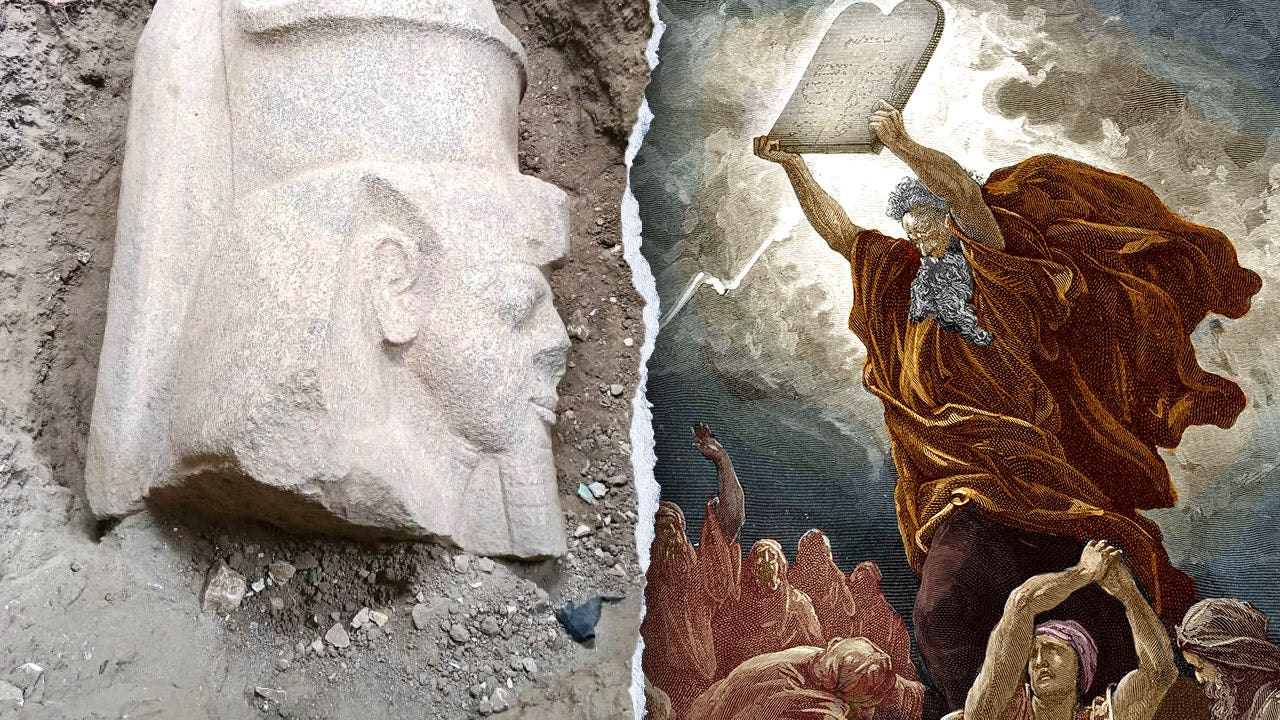
Ramses II statues: pink granite block found by Egyptian farmer led to 5-foot head; Moses link remains unproven
Rescue excavation at Behbeit el-Hagar in the Nile Delta recovered two statues attributed to Ramses II. The Bible never names the pharaoh of the Exodus.
Egyptian farmer uncovers two colossal statues of Ramses II, linked to Moses Photo: Fox News
Not yet confirmedUnder investigation. Here is what is known and what still needs proof.
Egyptian archaeologists with the Supreme Council of Antiquities have excavated the remains of two royal statues attributed to Ramses II at Behbeit el-Hagar in the Nile Delta, after a farmer found an inscribed block of pink granite and reported it to the authorities. Egypt's Ministry of Tourism and Antiquities announced the find in mid-October 2026. This is a rescue excavation reported through an official statement, not a peer-reviewed study, and the work is still under way. The Moses connection is not part of the discovery. It comes from an old hypothesis about who the pharaoh of the Exodus was, which a Fox News report put in its headline and which scholars still dispute.
A 5-foot head, an 8-foot torso and a block of royal titles
The farmer, Khaled al-Shahat, told CBS News he was working his land when he came across an unusual stone and informed the authorities. Accounts differ on exactly where. The Egyptian outlet Youm7, cited by Fox, says he was in a cucumber greenhouse, while the describes land in front of his home.
The local antiquities inspectorate began the legal procedures and documented the find. The Supreme Council then formed a committee and a specialist team to carry out rescue excavations. A rescue dig is not part of any research plan. It happens when something unexpected surfaces and has to be recorded before it is lost.
The first piece out of the ground was a colossal head of Ramses II. It stands about 1.6 meters (5 feet 3 inches) tall and shows the king in the double crown, the symbol of the union of Upper and Lower Egypt. Archaeologists also found the upper part of the statue's back pillar, inscribed with the king's formal Horus name, "Hor Ka Nakht Mery Maat." From the size of the head, they estimate that the complete statue may have stood nearly 28 feet tall, about 8.5 meters. That figure rests on proportions, as Supreme Council Secretary-General Hisham El-Leithy explained, and only parts of the colossus have been recovered. It is best read as a possibility.
The second statue is more complete. It forms the larger part of a royal statue, nearly 8 feet long, though it lacks legs and a base. The ministry says part of the top of its nemes headdress is also missing. The face is well preserved and resembles the first statue's. The third piece is a pink granite block about 1.3 meters long bearing two royal titles, "Nesw-Bity" (King of Upper and Lower Egypt) and "Sa-Ra" (Son of Ra). It lay about a meter north of the second statue.
On October 14, Minister Sherif Fathy visited the village and honored the farmer and his wife with certificates and a trip to Saudi Arabia for the Umrah pilgrimage. "They told me this might change the history of the area," al-Shahat told CBS.
A pharaoh's head in the village of Isis's temple
The village name holds a clue. "El-Hagar" means "the stones" in Arabic, and "Behbeit" comes from the ancient Egyptian Per-Hebyt, roughly "house of the festival." It sits on the Damietta branch of the Nile, about 5 miles (8 km) west of Mansoura. The stones of the name are the blocks of the Iseion, the great temple of Isis.
The Metropolitan Museum of Art explains that Nectanebo II built most of the temple in dark granite, and Ptolemy III added and decorated the hypostyle hall and western facade. The Montreal Museum of Fine Arts says a shrine to Isis likely existed on the site since the Old Kingdom. Because most Egyptian temples were built of limestone or sandstone, while the one at Behbeit was built entirely of granite, the site is unusual. The Met adds that the temple collapsed completely before the early third century A.D.
That is where the discovery becomes puzzling. Ramses II ruled from 1279 to 1213 B.C. Nectanebo II reigned from 360 to 342 B.C., more than eight centuries later. Two colossal statues of Ramses in the village of a late temple are not what anyone would expect. The ministry's statement does not say whether the statues were raised on this spot, brought from elsewhere or reused centuries later. Egyptian texts mention the site as early as the New Kingdom, Ramses' own era, although it may have been merely an offshoot of Sebennytos. Reuse of older monuments was common. In April 2026 the ministry announced another Ramses II statue at Tell el-Faraun in Sharqia province that had apparently been reused in antiquity and came from the royal capital Pi-Ramesses, according to La Brújula Verde. That case does not settle Behbeit's.
How experts tell whose statue it is when there is no name on the base
Stone cannot be dated directly in a lab. Egyptologists attribute a statue by its inscribed names and titles, by the style of the face and dress, and by the context where it turns up. For the colossal head, the Horus name on the back pillar is strong evidence. For the second statue, the ministry points to the resemblance of its face to the first. Its statement mentions no inscription with the king's name on that piece.
A note on the pink block: "King of Upper and Lower Egypt" and "Son of Ra" are formulas that come before the royal names written in cartouches, the oval ring around a king's name. The statement speaks of titles, and what the team publishes about the name that goes with them should help firm up the attribution.
There is a precedent for caution. In March 2017, an Egyptian-German team at Matariya in Cairo found fragments of a colossal quartzite statue about 8 meters tall, on the site of a temple of Ramses II. It was first presented as Ramses, but days later an inscription on its back carried a name of Psamtik I, who ruled from 664 to 610 B.C. Then-minister Khaled El-Enany left open the possibility that Psamtik had reused an older statue of Ramses.
Abu Simbel in southern Egypt gives a sense of scale. The entrance to the great temple is flanked by four colossal 20-meter statues, each showing Ramses II seated on a throne in the double crown. Even at the high estimate, the Behbeit statue would be much smaller.
What the Bible says about the pharaoh and why Ramses II enters the conversation
The Book of Exodus never names the pharaoh. It says a new king arose who did not know Joseph (Exodus 1:8) and that the Israelites built supply cities for him, Pithom and Raamses (Exodus 1:11). The same name appears when the people set out (Exodus 12:37; Numbers 33:3). Before Moses, pharaoh refuses to let the people go (Exodus 5:2), and the plagues follow.
The link to Ramses II comes from the city's name. German excavations at Qantir since 1980 have shown that it was the site of ancient Pi-Ramesses, on the Pelusiac branch of the Nile, far to the east of Behbeit. Egyptologist James Hoffmeier argues that the "late date" takes seriously the mention of Rameses in Exodus 1:11, which points to the reign of Ramses II, who indeed built a new city named for himself. Kenneth Kitchen likewise defends the broad historicity of the Exodus and argues that the lack of evidence in Sinai is unremarkable for nomadic movements.
The rival view is the "early date." Two competing theories developed: the late Exodus in the time of Ramses II, and the early Exodus, fixed at 1446 B.C. That date rests on 1 Kings 6:1, which puts 480 years between the Exodus and the fourth year of Solomon. Its defenders suggest that "Raamses" in Exodus 1:11 is a later name that replaced the original, Avaris. There is also an argument from the text itself: Exodus 2:23 says the pharaoh of the oppression died before Moses returned to Egypt. Those who raise it conclude that even if the builder of Pi-Ramesses was Ramses II, the pharaoh of the Exodus would be someone else. A common fallback among late-date supporters is his son and successor, Merneptah.
Then there is the skeptical camp. Israel Finkelstein and Neil Asher Silberman argue that archaeology has found no evidence of even a small band of Israelites wandering in Sinai. The Merneptah Stele, from about 1208 B.C., offers the earliest generally accepted extrabiblical evidence for a people called Israel, already in Canaan. The Biblical Archaeology Society put the state of play this month by saying the identity of the biblical pharaoh remains uncertain, while the historicity, chronology and archaeological background of the Exodus are still vigorously debated.
Where the headline overreaches
There are three points. The first is the word "giant." The head is 1.6 meters tall and the second torso is 2.4 meters long. The 8.5 meters is an estimate. The second is the Moses link. Fox itself notes that some scholars have suggested Ramses II was the unnamed pharaoh of Exodus, though the identification remains uncertain. In a headline, the "link" reads as part of the discovery. Even outlets celebrating the find acknowledged that the statues confirm royal activity at Behbeit El-Hagar but do not prove the identity of the biblical pharaoh or the events of Exodus.
The third is what the pieces actually say. No published inscription mentions Israelites, Moses or slavery. They show that Behbeit el-Hagar held images of Ramses II in some form, and when and why will depend on the work now under way. It also helps to remember that Ramses II left statues across Egypt and Nubia, so one more colossus of him does not by itself bring the biblical text closer to a name.
For readers of the Bible, the find is news about thirteenth-century B.C. Egypt and about a village that held, for centuries, stones from two very distant moments of Egyptian history. Reading Exodus does not depend on knowing which pharaoh these statues show, and the argument over that, as Hoffmeier, Kitchen and Finkelstein illustrate, is decades old and continuing.