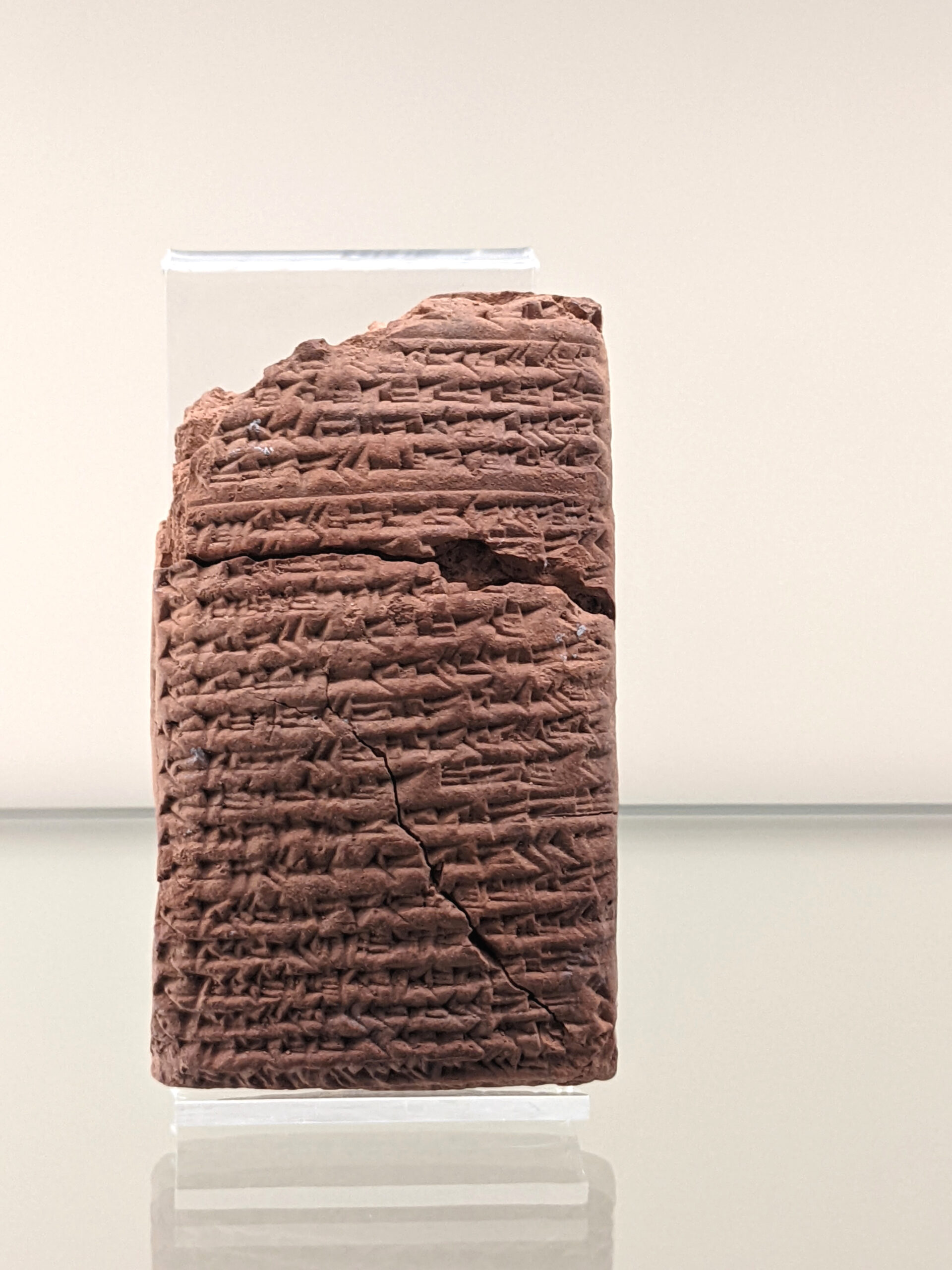
For decades, historians and archaeologists studying the ancient Near East faced a persistent dilemma. They knew the sequence in which kings reigned, cities flourished, and battles were fought, but they could not pinpoint exact calendar dates. The margin of uncertainty between competing academic models spanned decades and, in some cases, more than a century. A new scientific study led by the University of Arizona has combined ancient tree rings with polar ice cores to lock down Near Eastern chronology, establishing a firm anchor for Bronze Age events, including the fall of ancient Babylon and the era of King Hammurabi.
The research, published in the *Proceedings of the National Academy of Sciences* (PNAS), was led by dendroarchaeologist Charlotte Pearson, an associate professor at the University of Arizona's Laboratory of Tree-Ring Research. The team examined structural timbers retrieved from archaeological sites across Anatolia, including Kültepe, Acemhöyük, Gordion, and Porsuk, locations that maintained active trade networks with Mesopotamia during the Old Assyrian period. The findings demonstrated that the middle-low chronology offers the most accurate match for physical evidence from Mesopotamian history between 2000 BC and 1500 BC.
To transform ancient wood into a precision clock, scientists measured carbon-14 levels stored within individual annual growth rings. Because atmospheric radiocarbon levels fluctuate slightly each year due to variations in solar activity and cosmic radiation, these fluctuations function like a temporal barcode. By matching the radiocarbon patterns from Anatolian beams against a reference curve built from 735 tree samples of known age, the team anchored the Anatolian tree-ring sequence from 2072 BC to 744 BC. At the ancient city of Gordion, a distinct shift in radiocarbon detected between 1532 BC and 1531 BC allowed researchers to lock the timeline with single-year precision.
Tree rings, ice cores narrow timeline of Bronze Age Mesopotamia Photo: Dailynewsegypt
How ancient timber revealed Babylon's exact date
With the Anatolian tree-ring timeline securely anchored, researchers checked the construction dates of the buildings where the timbers were installed. Beams from the Waršama Palace at Kültepe were felled around 1837 BC or 1836 BC. Wooden elements from the Sarıkaya Palace at Acemhöyük yielded a date of 1778 BC. When these concrete dates were cross-referenced with Assyrian administrative and commercial tablets unearthed at the sites, the low chronology was ruled out as inconsistent with the physical data, leaving the middle chronology as the only mathematically sound explanation.
However, an eight-year discrepancy remained between two variations of the middle chronology. To resolve this final gap, the research team turned to an entirely different source of evidence: volcanic eruptions trapped in deep polar ice layers. Ancient Babylonian clay tablets known as the Enuma Anu Enlil Venus observations record atmospheric haze accompanying observations of the planet Venus. By analyzing Greenland and Antarctic ice cores, researchers identified the eruption of Alaska's Aniakchak II volcano in 1627 BC or 1628 BC, one of the largest volcanic events of the past four millennia. Only under the middle-low chronology do the Babylonian astronomical records align with the volcanic ash signals in polar ice.
This chronological alignment established that the fall of Babylon to Hittite invaders occurred around 1587 BC. Likewise, the 32nd year of King Hammurabi's reign was pinned to 1754 BC. This adjustment established a direct synchronism with ancient Egypt, where the reign of Pharaoh Neferhotep I had been independently estimated to the same timeframe, confirming historical connections across ancient superpowers.
Why this new chronology matters for biblical historical context
Establishing precise dates in Mesopotamian history is far more than an academic exercise for students of the Bible. The civilizations of Mesopotamia, Anatolia, Egypt, and the Levant were deeply interconnected throughout Old Testament history. The Scriptures record kings, empires, international treaties, and migrations taking place across these regions. When secular Near Eastern timelines floated by up to a century, skeptics frequently cited these gaps to claim that patriarchal narratives or recorded interactions between Israel and its neighbors contained historical anachronisms.
By anchoring Hammurabi's reign firmly in the 18th century BC, historians gain a reliable benchmark for studying the patriarchal era described in Genesis. In Genesis 14:1, the Bible recounts a coalition of Eastern kings, including Amraphel king of Shinar, whom many scholars link to rulers of Babylon's first dynasty. Having concrete calendar dates grounded in tree-ring science removes speculative guesswork surrounding synchronisms between the biblical text and ancient Near Eastern history.
Furthermore, the PNAS study pinned down a multi-decadal drought in Anatolia between 1228 BC and 1188 BC. This climate event included a severe three-year drought from 1194 BC to 1192 BC, occurring shortly before the destruction of Hattusa, capital of the Hittite Empire. The confirmation of this severe climate crisis provides a verified background for regional population movements at the end of the Bronze Age, a period that coincides with Israel's settlement in Canaan following the Exodus.
Solar superstorm in 664 BC confirms Neo-Assyrian tablet records
The application of tree rings to biblical archaeology received further support from a complementary study. A team led by researcher Irina Panyushkina, also of the University of Arizona Laboratory of Tree-Ring Research, investigated a sudden spike in atmospheric radiation in the 7th century BC, published in *Communications Earth & Environment*.
Analyzing larch logs preserved in Siberian permafrost and wood from a Pazyryk Scythian burial mound in Russia's Altai Mountains, the team discovered a sharp rise in carbon-14 dating to 664 BC to 663 BC. This isotope spike indicates a massive solar proton event, known as a Miyake event. Independent verification came from measuring beryllium-10 levels in polar ice cores from Greenland and Antarctica.
The 664 BC radiocarbon spike directly matches astronomical reports on clay tablets from the Neo-Assyrian Empire preserved at Nineveh. Assyrian scribes writing during the reigns of Esarhaddon and Ashurbanipal recorded intense red glows filling the night sky, a phenomenon now understood as powerful auroras triggered by a solar superstorm. The convergence of tree biology, ice core chemistry, and cuneiform inscriptions highlights how modern science and textual archaeology work together to illuminate the world of the Bible.
The Herald covers what almost no one else does: the persecuted church, the discovery that confirms the Bible, the faith that never makes the evening news. No subscription, no paywall, no outside advertisers. If this story mattered to you, help the next one get written.