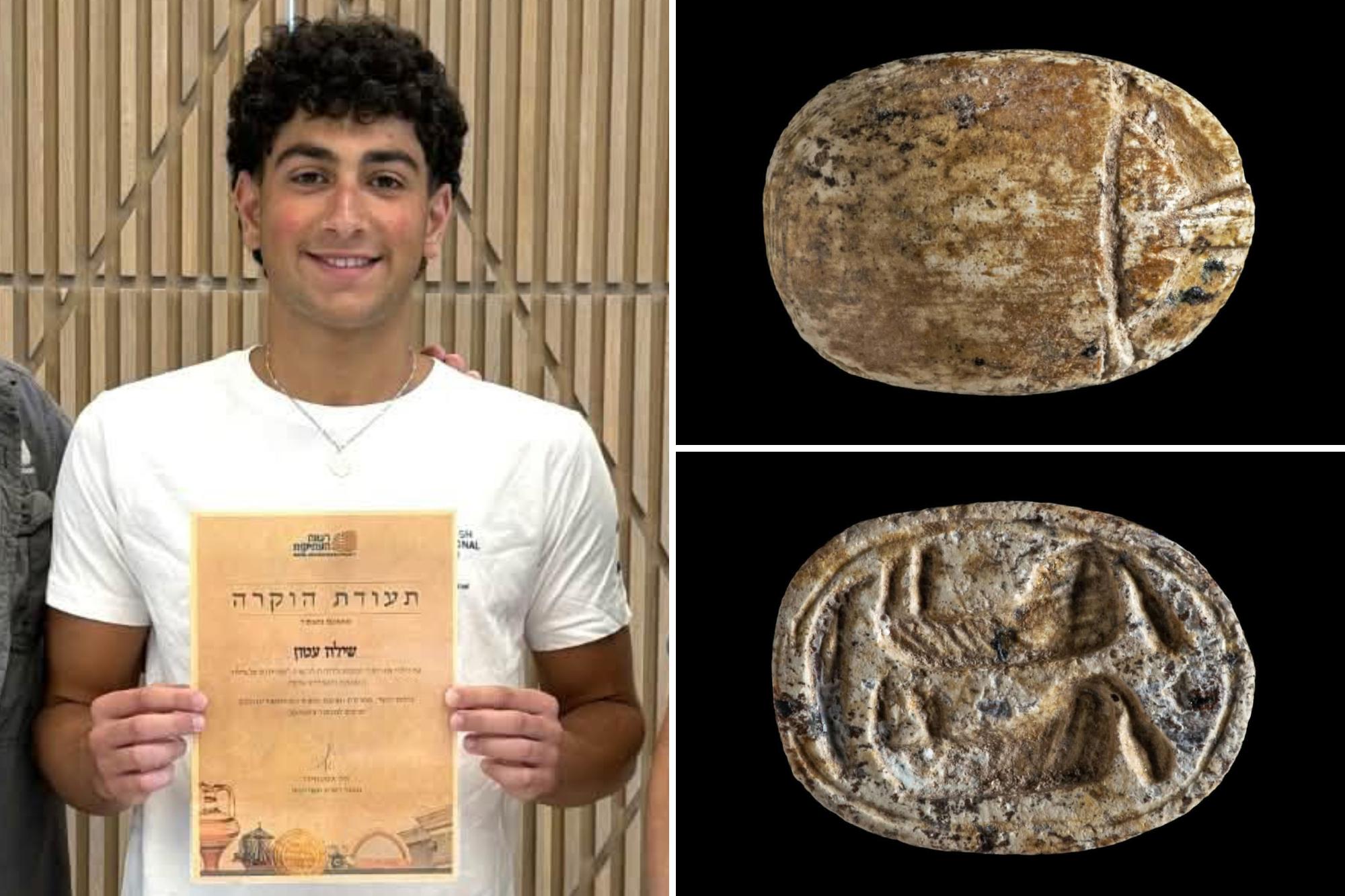
Just two days after landing in Israel to begin a semester of study, 17-year-old American high school student Shiloh Attoun was walking with his classmates among the limestone ruins and grassy hillsides of Tel Gezer National Park in the Judean Lowlands. It was the very first field excursion for the group from Muss High School Israel, operated by Jewish National Fund-USA. As instructors explained the strategic geopolitical importance of the ancient Bronze Age fortified city, Attoun glanced down at the dirt trail and noticed a small, distinctively shaped stone resting loosely on the ground. Picking it up and gently wiping away the soil, he realized it was no ordinary pebble, but a 3,300-year-old Egyptian-style scarab amulet engraved with sacred serpents and ancient hieroglyphs.
The remarkable discovery occurred right during a hands-on history lesson. Attoun recalled that moments before his discovery, the tour guide was chatting with students about how unlikely it was to ever encounter an authentic ancient artifact lying right on the surface. The student immediately showed the object to his guide. Dean of students Benji Hain and Attoun promptly reported the find to the Israel Antiquities Authority (IAA), as reported by the New York Post. Archaeologist Adam William Asper, an IAA supervisor for the Central Region, arrived at the site to collect the artifact for Israel's National Treasures collection. Attoun was later awarded a certificate of appreciation for his responsible actions.
Egyptian iconography and the sacred royal cobra
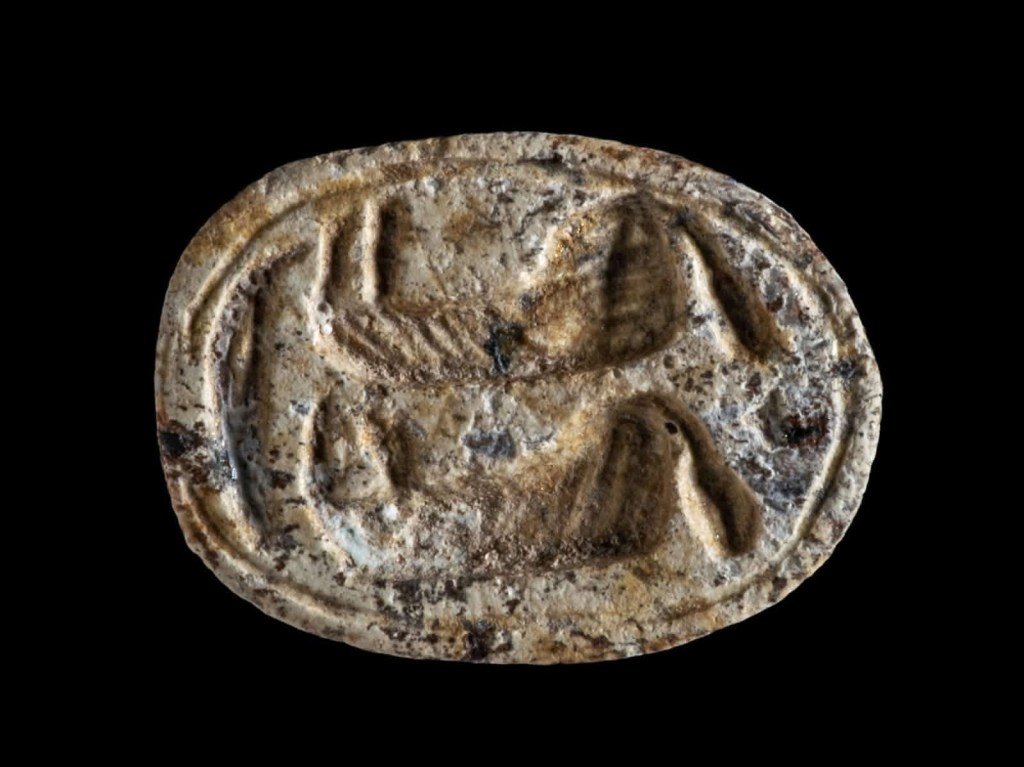
Initial analysis of the small scarab was conducted by Professor Ido Koch from Tel Aviv University's Department of Archaeology and Ancient Near Eastern Cultures. Koch dated the artifact to the Late Bronze Age, approximately 3,300 years ago (13th century BC), a period defined by heavy Egyptian imperial administration across the Southern Levant. On the flat underside of the carved stone amulet appears a well-defined iconographic scene: two cobras positioned above a semi-ellipse. In ancient Egyptian iconography, the cobra was known as the *Uraeus*, a sacred serpent representing divine protection and pharaonic authority.
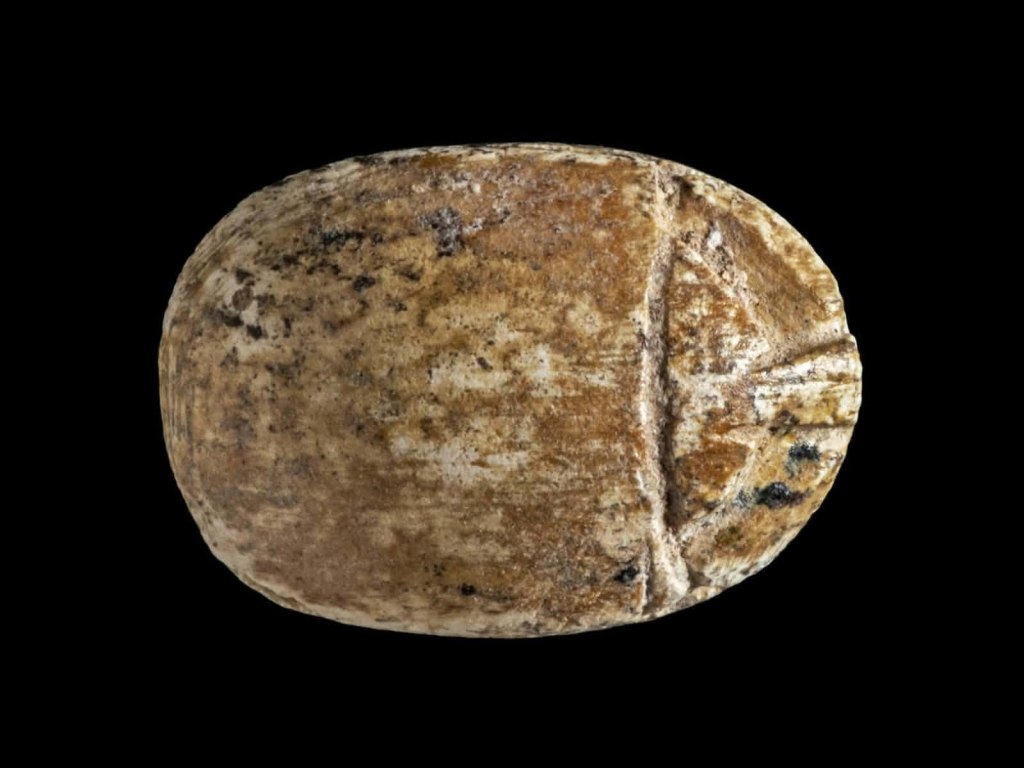
Directly beneath the pair of cobras, the semi-elliptical shape corresponds to the Egyptian hieroglyphic sign *nb*, which translates to "lord" or "master." The combination of protective cobras and the hieroglyph conveyed a potent message of divine patronage and royal favor to whoever wore or carried the artifact. According to Professor Koch, scarabs modeled after the dung beetle (*Scarabaeus sacer*) were ubiquitous in ancient Egypt and its vassal territories. To the ancient Egyptians, the beetle symbolized the god Khepri, associated with daily creation, the rising sun, and the renewal of life. Scarabs were frequently used as personal protective charms or carved on their bases to function as official administrative seals.
Professor Koch noted that similar discoveries have been made at other strategic sites across Israel. A comparable scarab depicting three snakes was previously excavated at ancient Tel Megiddo. Scarabs found in Israel attest to ancient Egypt's deep cultural dominance and highlight the administrative integration of the Land of Israel into pharaonic power networks during periods of Egyptian rule.
Shiloh Attoun discovered a 3,300-year-old Egyptian-style amulet during a tour of Tel Gezer National Park in the Judean Lowlands, Israel. Israel Antiquities Authority Photo: New York Post
Tel Gezer in biblical history and Bronze Age diplomacy
The geographical setting of the discovery adds immense historical depth to the find. Tel Gezer was one of the most prominent Canaanite city-states in the ancient Near East. Perched atop the rolling hills of the Shephelah (the Judean Lowlands), Gezer overlooked the vital intersection of the coastal highway — the *Via Maris*, connecting Egypt to Mesopotamia — and the trunk road leading upward through the mountains toward Jerusalem and the Jordan Valley. Whichever power controlled Gezer held sway over merchant caravans, military legions, and royal emissaries travelling across central Canaan.
For readers of the Bible, Gezer carries significant historical and theological resonance. The Book of Joshua records that Horam, king of Gezer, marched his army to assist the city of Lachish, only to be defeated in battle (Joshua 10:33). Later, Joshua 16:10 notes that Canaanites continued to dwell in Gezer among the tribe of Ephraim, serving as forced laborers. The city re-emerges prominently in the First Book of Kings during the reign of King Solomon. The Scripture records: "And this is the account of the forced labor that King Solomon drafted to build the house of the Lord and his own house and the Millo and the wall of Jerusalem and Hazor and Megiddo and Gezer" (1 Kings 9:15).
The biblical text provides an intriguing historical detail connecting Gezer directly to Egypt: "Pharaoh king of Egypt had gone up and captured Gezer and burned it with fire, and had killed the Canaanites who lived in the city, and had given it as a dowry to his daughter, Solomon's wife" (1 Kings 9:16). Solomon subsequently rebuilt and fortified Gezer, securing the kingdom's western defense (1 Kings 9:17). The discovery of a 3,300-year-old Egyptian amulet at this exact site tangibly illustrates the layered Egyptian and Canaanite presence that existed centuries prior to Solomon's monumental building campaigns.
Archaeological ethics and preservation guidelines
The swift action taken by the student and school staff highlighted the vital role of archaeological ethics in field education. Dean of students Benji Hain shared that while the find sparked tremendous excitement among the class, their immediate responsibility was to follow proper scientific protocol. As soon as we realized this was a significant find, we reported it immediately to allow archaeologists to document the artifact, Hain explained. IAA Central Region educational director Amit Melman praised Attoun and his instructors, noting that their honesty ensures the object is preserved for scholarly research.
Melman emphasized that the discovery demonstrates how educational tours allow young people from the diaspora to connect directly with the living history of the land. Touching an object crafted thousands of years ago transforms textbook history into an unforgettable personal experience. Similarly, Jewish National Fund-USA director Tali Tzour Avner and Israeli Heritage Minister Amichai Eliyahu commended the student's civic responsibility, noting that proper reporting safeguards the cultural and biblical heritage of Israel.
The Israel Antiquities Authority reiterated official guidelines for members of the public who encounter ancient items. Anyone who discovers an artifact while hiking or exploring national parks should leave the object in place and report its exact location to authorities immediately. Maintaining the surrounding soil layers and archaeological context is essential for researchers to determine the precise date, occupational layer, and historical function of every discovery.
Now housed in Israel's National Treasures collection, the 3,300-year-old scarab found by Shiloh Attoun will undergo further study by experts in Egyptology and Levantine archaeology. The small stone scarab remains a silent witness to the ancient armies, traders, and officials who traversed the crossroads of Tel Gezer, connecting the world of the pharaohs to the historical narrative of the Bible.
Scarabs—amulets modeled after the dung beetle—were common in ancient Egypt and were sometimes used as seals. The beetle symbolized creation and new life in Egyptian belief. Israel Antiquities Authority Photo: New York Post
Scarabs found in Israel attest to ancient Egypt’s cultural influence on the region and its connections with the Land of Israel during periods of Egyptian rule. Israel Antiquities Authority Photo: New York Post